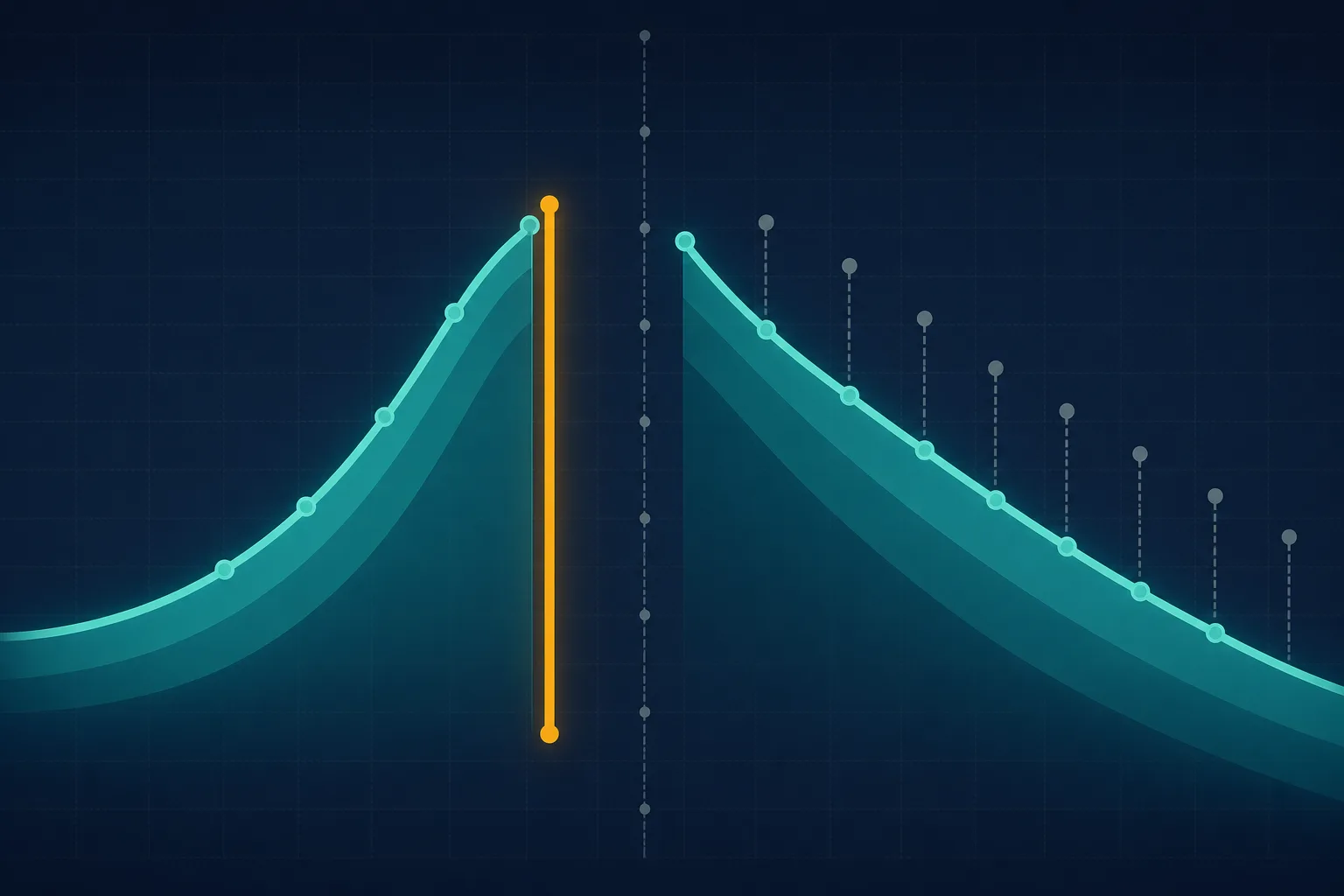
The rules of trend following are not complicated. They fit in three sentences: buy on a breakout, leave when the preset stop is hit, and in profit wait until the exit condition appears. Yet results still differ widely, and the reason is execution, not the difficulty of the rules.
This problem is often explained as a lack of willpower in the individual, but behavioral finance research reports that the behavior is a widely observed pattern, not a quirk of particular people. This post uses that research to point out where execution fails and lays out how to handle psychology as structure instead of willpower.
Trend-following series, Part 8. The previous post is Part 7, Building a Trading System and the next is Part 9, The Limits of Trend Following. The series index is in Part 0.
The Disposition Effect: Lock In Gains Fast, Put Off Losses
In behavioral finance, the disposition effect refers to the tendency to sell assets that are up quickly and to hold assets that are down for a long time. Shefrin and Statman introduced the term in 1985, and it was later tested on actual account data.
"Are Investors Reluctant to Realize Their Losses?" by Terrance Odean, published in The Journal of Finance in 1998, analyzed the trading records of 10,000 individual accounts at a large discount brokerage. It reported that investors were about 1.5 to 2 times as likely to sell a stock showing a gain as a stock showing a loss. The study found that this behavior is not explained by portfolio rebalancing, trading costs or taxes, and is not justified by subsequent returns.
The reason this result matters for trend following is clear. The disposition effect points in exactly the opposite direction from the behavior trend following requires.
Recall the expectancy calculation from Part 0 and you can see why this combination is fatal. The expectancy of trend following rests on a small average loss and a large average gain. The disposition effect pushes both values in the wrong direction at once. Even with the same win rate, the sign can flip.
Loss Aversion: The Same Size of Loss Feels Bigger
Loss aversion is often cited as the background to the disposition effect. Kahneman and Tversky's prospect theory (1979) explains that people evaluate gains and losses as changes from a reference point rather than as absolute wealth levels, and that, at the same size, the psychological impact of a loss is larger than the satisfaction from a gain.
On top of that, prospect theory holds that in the domain of losses people tend to take more risk. That is, they prefer an uncertain state that might recover to a small loss that is certain. In trading, this tendency shows up as stop avoidance. The moment you press the stop button the loss becomes real, but while you keep holding, it still feels like it is not a loss yet.
This explanation is useful because it shows that stop avoidance is not a matter of missing information. If you know you should cut the loss and your behavior does not change, adding more knowledge will not solve it.
Trading Frequency: More Trades Do Not Improve Results
Failures of execution do not appear only as early selling and stop avoidance. They also appear as adding trades that are not in the rules.
"Trading Is Hazardous to Your Wealth," published by Barber and Odean in The Journal of Finance in 2000, analyzed 66,465 individual accounts at a large discount brokerage from 1991 to 1996. Over that period the average household earned 16.4% a year with annual turnover of 75%. The group that traded most often, by contrast, earned 11.4% a year, well below the market return of 17.9% over the same period.
The study points to overconfidence as the cause of excessive trading. In the context of trend following, this is the behavior of being unable to wait through a stretch with no signal and loosening the conditions to enter. The reason Part 7 puts a market filter in the rules is to make "not entering" an explicit decision item.
Still, it is hard to apply these figures directly to the Korean market. The sample, period and market environment differ, and so does the cost structure of trading in Korea. What carries over from this study is not a specific number but the observation that trading frequency does not automatically go with performance.

Four Points Where Execution Breaks Down in Trend Following
Map the studies above onto the trading process and the points where execution breaks down narrow to roughly four.
The third point is especially important in trend following. As seen in Part 3, the original Turtle document also says you have to watch a large share of the profit disappear while you wait for a 10-day or 20-day new low, and that this exit rule was the hardest item in the system to follow. Behavior meant to avoid a pullback looks reasonable on any single trade, but it destroys the structure itself, in which a few big gains cover many small losses.
The fourth point creates a separate problem, because it makes validation impossible. Once trades outside the rules get mixed in, when results are poor you cannot tell whether the rules or the execution is the problem.
Handling Psychology as Structure, Not Willpower
The fact that this problem is so widely observed also means that trying to solve it through personal resolve does not work well. The approach used in practice leans toward reducing the number of moments that call for a judgment.
First, move the decisions to before the trade. If you fix the stop price, exit condition and size before entry, there is less to newly decide in the loss zone. If you set the criterion after a loss has occurred, your emotions at that moment get built into it.
Second, adjust intensity through size. If following the stop is hard, the problem is often not the stop rule but a position that is too large. As in the calculation in Part 4, setting the loss on a single trade at about 1% of the account lowers the psychological burden of executing the stop itself.
Third, record whether you followed the rules separately from the result. Whether the result was good and whether you followed the rules are different items. A trade that broke the rules and still turned out well is the most dangerous case, because it makes you repeat the same behavior next time, so it is better to flag those trades separately.
The purpose of this record is classification, not self-blame. If the trades where you broke the rules cluster in particular situations (right after consecutive losses, right after a big gain, on a sharp market drop day), you can respond by writing a separate rule for those situations.
Checkpoints for Investors
- Did you fix the stop price and exit condition before entry, or after?
- In your recent trades, how many did you sell before the exit condition?
- Is your actual average loss exceeding the loss range you planned?
- If you put off a stop on any trade, what was the state of the account at the time?
- How many recent trades did you enter on conditions not in the rules?
- Have you flagged separately the trades that broke the rules but turned out well?
- Is your position size so large that it is hard to execute the stop?
Frequently Asked Questions
Q1. Stops are psychologically hard. What should I do?
It often helps to check position size before the stop itself. If a single loss is a large share of the account, the burden of executing it is that much greater.
Also, setting the stop price before entry leaves less to newly decide in the loss zone. If you set the criterion after the loss has occurred, your feelings at that moment get mixed into it.
Q2. Is it a problem if I broke the rules and still made a profit?
On results alone it looks fine, but from the standpoint of learning, it is the most dangerous case. When a wrong behavior is reinforced by a good outcome, you are more likely to repeat it in the same situation next time.
If you flag these trades separately, then when a loss occurs later you can tell whether the cause was the rules or the execution.
Q3. Will cutting the number of trades improve my results?
Not automatically. The Barber and Odean study reported the observation that the group that traded often performed worse; it did not prove that cutting the number of trades increases profit.
What matters is not the count itself but whether the trades follow the rules. If trades outside the rules are piling up, cutting the count can be a response.
Key Takeaways
In trend following, the gap in results comes more from how well the rules are executed than from how good the rules are.
- The disposition effect is the tendency to lock in gains quickly and put off losses, and Odean (1998) reported that winning stocks were 1.5 to 2 times as likely to be sold as losing stocks.
- This behavior turns trend following's expectancy structure of "small average loss, large average gain" exactly upside down.
- Loss aversion and the tendency to take risk in the domain of losses show that stop avoidance is not a problem of missing knowledge.
- In the Barber and Odean (2000) analysis, the group that traded most often earned 11.4% a year, below the market return of 17.9%.
- Execution problems are more realistically handled with decisions made in advance, smaller position size and records of rule compliance than with willpower.
Psychology is invisible, but it leaves a trace in records. If, for each trade, you write down the stop price at entry, the actual reason for the exit and whether you followed the rules, you can tell whether poor results come from the market or from your own execution.
References
- Terrance Odean, "Are Investors Reluctant to Realize Their Losses?", The Journal of Finance, 1998
- Brad M. Barber, Terrance Odean, "Trading Is Hazardous to Your Wealth: The Common Stock Investment Performance of Individual Investors", The Journal of Finance, 2000
- Hersh Shefrin, Meir Statman, "The Disposition to Sell Winners Too Early and Ride Losers Too Long", The Journal of Finance, 1985
- Daniel Kahneman, Amos Tversky, "Prospect Theory: An Analysis of Decision under Risk", Econometrica, 1979
- OriginalTurtles.org, "The Original Turtle Trading Rules", 2003
For reference only: The information in this post is provided for general reference and does not constitute investment advice or a solicitation to trade. Your responsibility: Final investment decisions and their outcomes are entirely your own. No warranty: This information is not guaranteed to be accurate and cannot be used as a basis for legal liability for any investment result.