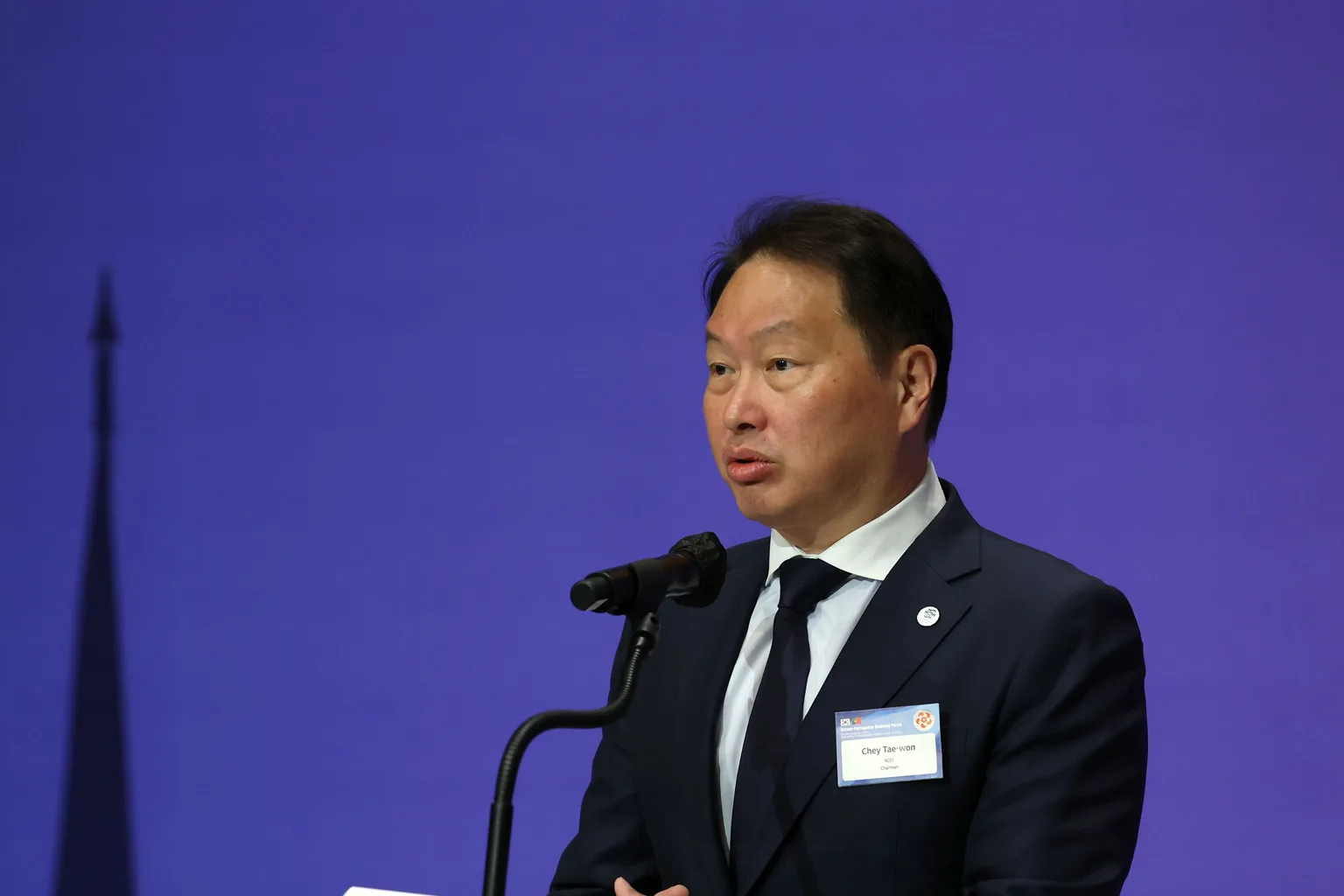
Photo: Republic of Korea (photo by Jeon Han), CC BY-SA 2.0, via Wikimedia Commons, cropped
A semiconductor supercycle is market shorthand for a stretch in which memory prices and chipmaker profits rise further and for longer than in an ordinary upturn. The phrase came back into heavy use in 2025, when the earnings and share prices of Samsung Electronics and SK hynix blew past their previous peaks.
The word still contains "cycle," though. Korea's memory industry went through boom and bust for decades, and investors built trading rules around that rhythm. Part 1 covers why memory was a cyclical business, how Hynix came close to being sold several times along the way, and the logic behind the Korean rule of thumb that chip stocks are valued on price-to-book (PBR), not price-to-earnings (PER), using figures from primary sources.
Korean Chip Supercycle series. This is Part 1. Part 2 covers what changed this time: AI and HBM, Samsung's recovery and the Tesla contract, and Korea's Commercial Act reform.
What Made Memory Chips a Cyclical Business?
DRAM and NAND flash are standardized commodities. A part that meets the spec works whoever made it, so prices are set by supply and demand at the time rather than by brand. Supply only grows when new fabs are built, and a fab takes years and trillions of won. Capacity approved while demand is strong often arrives after demand has turned, and prices collapse.
Chipmakers spell this out in their own filings. Micron's fiscal 2019 annual report (Form 10-K) said average selling prices fell 30% for DRAM and 44% for NAND from the prior year. In fiscal 2023, DRAM prices fell in the high-40s percent range and NAND in the low-50s, and Micron noted that prices had recently been below its manufacturing cost.
Contract prices, which swing less than spot prices, told the same story. Citing DRAMeXchange, the Korea Economic Daily reported that the contract price of a PC DDR4 8Gb chip fell from $4.10 in September 2021 to $1.30 in August and September 2023, a drop of about 68% in two years.

The Chicken Game: How Memory Narrowed to Three Players
When a downturn drags on, the high-cost producers fail first. The DRAM price war that ran from around 2007 to 2012 is often called a "chicken game," because no one cut output first even as prices sank below cost.
It ended in bankruptcies. Qimonda, the memory unit of Germany's Infineon, filed for insolvency at the Munich court on January 23, 2009. Japan's Elpida filed with the Tokyo District Court on February 27, 2012, with 448 billion yen of debt, the largest manufacturing bankruptcy in Japan at the time. Micron completed its acquisition of Elpida on July 31, 2013.
After that, three companies held most of the DRAM market. Citing IHS, NewDaily reported 2014 DRAM shares of 40.4% for Samsung, 27.4% for SK hynix and 24.6% for Micron including Elpida. With fewer rivals, analysts argued that reckless capacity additions in a downturn would become rarer. Even so, deep downturns returned in 2018-2019 and 2022-2023.
The Lesser-Known Story: Hynix Was Nearly Sold Several Times
In 2025 SK hynix earned more operating profit than all of Samsung Electronics for the first time. Two decades earlier, it was struggling to survive on its own and was put up for sale more than once.
It began with the government-driven restructuring of Korea's conglomerates after the 1997 Asian financial crisis, the so-called "Big Deal." On May 20, 1999, Hyundai Electronics agreed to buy 59% of LG Semicon from LG Electronics for 2.56 trillion won. In March 2001 the combined company's board voted to rename it Hynix Semiconductor.
DRAM prices crashed that year, and Hynix ran into a liquidity crisis. A creditor-led workout began in October 2001. The rescue plan finalized on October 31 included 650 billion won of new money and lower interest on existing loans. According to the Seoul Economic Daily, Hynix received 4.9 trillion won of debt-to-equity swaps and 1.4 trillion won of debt forgiveness over two rounds before exiting the workout in July 2005.
The most dramatic episode was the 2002 attempt to sell the memory business to Micron. A memorandum of understanding announced on April 22, 2002 would have swapped Hynix's memory operations for about 108.6 million Micron shares, worth about $3.2 billion at the prior close; reported values moved between $3 billion and $4 billion as Micron's stock moved. Creditors approved it on April 29. On April 30, after a meeting of more than five hours, all ten Hynix directors voted it down, arguing that Micron's shares were overvalued and that Hynix could survive on its own. Micron withdrew on May 2.
After Hyosung and STX walked away, SK Telecom was the bidder left. It bought 44.25 million existing shares and 101.85 million new shares for a 21.05% stake, and the 2.34 trillion won paid for the new shares went to Hynix itself. The company was renamed SK hynix in March 2012.
There was resistance inside SK Group too. In a 2017 article, Hankyung Business magazine reported that when insiders asked why SK should take on a business it had never run, chairman Chey Tae-won told the board, "Trust me, I'm confident I can make Hynix succeed." The magazine reconstructed this exchange; it is not a transcript.
Had the Micron deal gone through, there would be no 2025 moment of Hynix overtaking Samsung. The board's 2002 rejection rested on a judgment about standalone survival made at the bottom of a cycle, and it shows how differently such decisions can look in the next upturn.
Two Downturns: 2018-2019 and 2022-2023
The cycle did not disappear after the chicken game. Samsung's semiconductor operating profit fell from 44.57 trillion won in 2018 to 14.02 trillion won in 2019, down about 68.5%. SK hynix posted a record 20.8 trillion won of operating profit in 2018, and then its stock slid.
The 2022-2023 downturn went deeper.
On April 7, 2023, Samsung reported preliminary first-quarter operating profit of 600 billion won, down 95.75% from a year earlier, and said it would cut memory output "to a meaningful level." Samsung had long said it would not make artificial cuts, and Hankyung Business described it as the first such cut in about 25 years.
Chart data
Chart summary: SK hynix (000660) daily candles, 2022-01-03 to 2023-12-28. Close 128,500 KRW → 141,500 KRW (+10.1%); period high 143,700 (2023-12-22), low 73,100 (2023-01-03). Marked: Q4'22 1st loss 2023-02-01 close 91,400, Samsung cuts 2023-04-07 close 89,100.
Why Investors Used PBR Instead of PER
PER divides the share price by earnings per share, and PBR divides it by book value per share. For an ordinary company, a lower PER reads as cheaper relative to earnings. For a memory maker whose profits swing hard, that reading often ran backwards.
At the end of a boom, earnings peak, so PER looks lowest. At the bottom of a bust, earnings collapse or turn negative, so PER becomes very high or cannot be calculated at all. In a 2023 piece, Toss Securities analyst Han Sang-won explained that a cyclical stock's PER moves opposite to its price while PBR moves with it, and cited the rule of thumb "buy when PER is high, sell when it is low." SK Securities analyst Han Dong-hee told the Korea Economic Daily in 2025 that PER had never explained memory share prices well, which is why PBR was the main yardstick.
2018 is the textbook case. Park Jong-hoon of the Knowledge Economy Research Institute, cited by Newsis, noted that SK hynix's record 2018 profit pushed its PER down to 4.6x, and the stock then fell 42%. The moment it looked cheapest on PER was in fact the cycle top.
Book value changes far more slowly than earnings, so PBR served as a reference point that held across the cycle. Investors used a "PBR band" approach: buy when PBR reached its historical floor and sell when it reached its historical ceiling.

How to Interpret the PBR Band
Brokerages have summarized the historical bands roughly as follows. The figures differ by basis, trailing book value versus 12-month forward book value, so check the basis for each source.
When Money Today reported this band in October 2022, Samsung traded at 1.07x book, close to its historical trough average. In the SK hynix chart above, the lowest close was 75,000 won on December 29, 2022, before the first quarterly loss was announced on February 1, 2023. The losses lasted through Q3 2023, yet the stock rose throughout and closed 2023 at 141,500 won on December 28. The share price bottomed before the earnings did. The PBR band was a way of using that lag.
That did not mean "below 1x book always rebounds." A KB Securities analysis cited by the Kyunghyang Shinmun found that of five past episodes when Samsung traded below 1x book, the stock rebounded right away in 2008 and 2011 but fell further in 2014, 2015 and 2018. For this post we found no brokerage backtest of the cumulative return from buying at 1x and selling at 2x. The band marked zones where the odds had been favorable, not a rule that guaranteed returns.
Reliable vs. Risky Uses of the PBR Band
The band worked best when the industry structure behind the historical range still held, when contract prices had stopped falling or the declines were narrowing, and when producers had announced output or capex cuts. Samsung's April 2023 production cut, arriving while SK hynix traded near its band floor, fit that pattern.
It was risky when the low PBR reflected a company-specific problem rather than the cycle, when supply was still growing, or when the investor mixed trailing and forward figures. A PBR below 1x can persist for a long time if the book value itself is no longer expected to earn what it used to.
Limitations and Risks
First, the yardstick moves. Trailing and forward PBR differ on the same day, and losses at the bottom shrink book value, which can make PBR look higher than expected. Without fixing which number is the reference line, the same chart can support opposite conclusions.
Second, there can be a floor below the floor. As the KB Securities analysis shows, 1x book was breached several times. For a company whose oversupply is not clearing, or whose competitiveness has slipped, a cheap-looking PBR can become a value trap that lasts.
Third, if the industry structure changes, the band itself can stop meaning anything. In 2025-2026 SK hynix traded far above its historical PBR ceiling, and some brokerages switched to PER-based valuation. Part 2 looks at whether that was "this time is different" or the top of a bigger cycle.
Fourth, Korean market flows move prices a lot. Samsung Electronics and SK hynix have high foreign ownership and huge weights in the KOSPI, so index fund flows unrelated to company results can swing their PBR sharply.
A Checklist Before Acting
- Have you confirmed whether the PBR you are looking at is trailing or forward?
- Did the industry structure (number of competitors, product mix) during the historical band period match today's?
- Are memory contract prices still falling, or are the declines narrowing?
- Have producers announced output or capex cuts that reduce supply?
- Could a low PER simply reflect peak-cycle earnings?
- Have you recorded the PBR figure, its source and its date as part of your trade rationale?
Frequently Asked Questions
What is the difference between a semiconductor supercycle and a normal cycle?
There is no formal definition. Markets use "supercycle" when memory price increases and profit growth run longer and larger than in a normal upturn.
The key point is that a supercycle is still a cycle. The size and length of the upturn change, but the structure in which prices can turn once supply catches up with demand remains.
Is a stock below 1x book always undervalued?
No. Samsung rebounded right away in some years when it fell below 1x book and kept falling in others.
A PBR of 1x only means the market values the company at its book value. Whether that book value will keep earning what it did is a separate judgment that depends on the industry, supply discipline and the company's technology position.
Key Takeaways
- Memory chips are commodities and fabs take years to build, so the lag between demand and new supply drove sharp price swings.
- After Qimonda's 2009 bankruptcy and Elpida's in 2012, the DRAM market settled into three players: Samsung, SK hynix and Micron.
- Hynix's board rejected a 2002 sale to Micron, bids from Hyosung and STX fell through, and SK Telecom acquired the company in 2012.
- Because memory earnings swing so much, PER moved against the cycle, and the PBR band (about 1x at the floor, about 2x at the ceiling) became the trading reference.
- Samsung sometimes fell further below 1x book, and the band can break depending on the basis used (trailing or forward) and on structural change in the industry.
References
- Micron Technology, Form 10-K FY2019 and Form 10-K FY2023
- Korea Economic Daily (KED Global), "DRAM prices", Oct 4, 2023 (citing DRAMeXchange DDR4 8Gb contract prices)
- Infineon, "Qimonda files for insolvency", Jan 23, 2009
- Bloomberg, "Elpida's Bankruptcy Filing", Feb 27, 2012
- Micron Technology, Elpida acquisition press release (8-K exhibit), Jul 31, 2013
- NewDaily, "2014 DRAM market share", Apr 10, 2015 (Korean)
- Samsung Semiconductor, company history
- SK hynix Newsroom, Hyundai Electronics and LG Semicon integration, 1999 (Korean)
- Seoul Shinmun, Hynix rescue plan, Nov 1, 2001, and board rejects sale, May 1, 2002 (Korean)
- EE Times, "Micron, Hynix sign MOU", Apr 22, 2002
- Money Today, Hyosung drops Hynix bid, Nov 12, 2009, and SK Telecom signs Hynix deal, Nov 14, 2011 (Korean)
- Hankyung Business, Chey Tae-won and Hynix, Jul 11, 2017 (Korean)
- Dailian, Samsung 2019 results, Jan 30, 2020 (Korean)
- SK hynix Newsroom, 2023 business results, Jan 25, 2024 (Korean)
- Hankyung Business, Samsung announces output cut, April 2023 (Korean)
- Toss Securities, "Why chip stocks are valued on PBR, not PER", May 4, 2023 (Korean)
- Korea Economic Daily, interview with SK Securities' Han Dong-hee, Nov 3, 2025 (Korean)
- Newsis, SK hynix and the PER trap, Jul 30, 2026 (Korean)
- Money Today, Samsung's PBR trough, Oct 22, 2022 (Korean)
- Kyunghyang Shinmun, Samsung below 1x book, Nov 17, 2024 (Korean)
For reference only: The information in this post is provided for general reference and does not constitute investment advice or a solicitation to trade. Your responsibility: Final investment decisions and their outcomes are entirely your own. No warranty: This information is not guaranteed to be accurate and cannot be used as a basis for legal liability for any investment result.