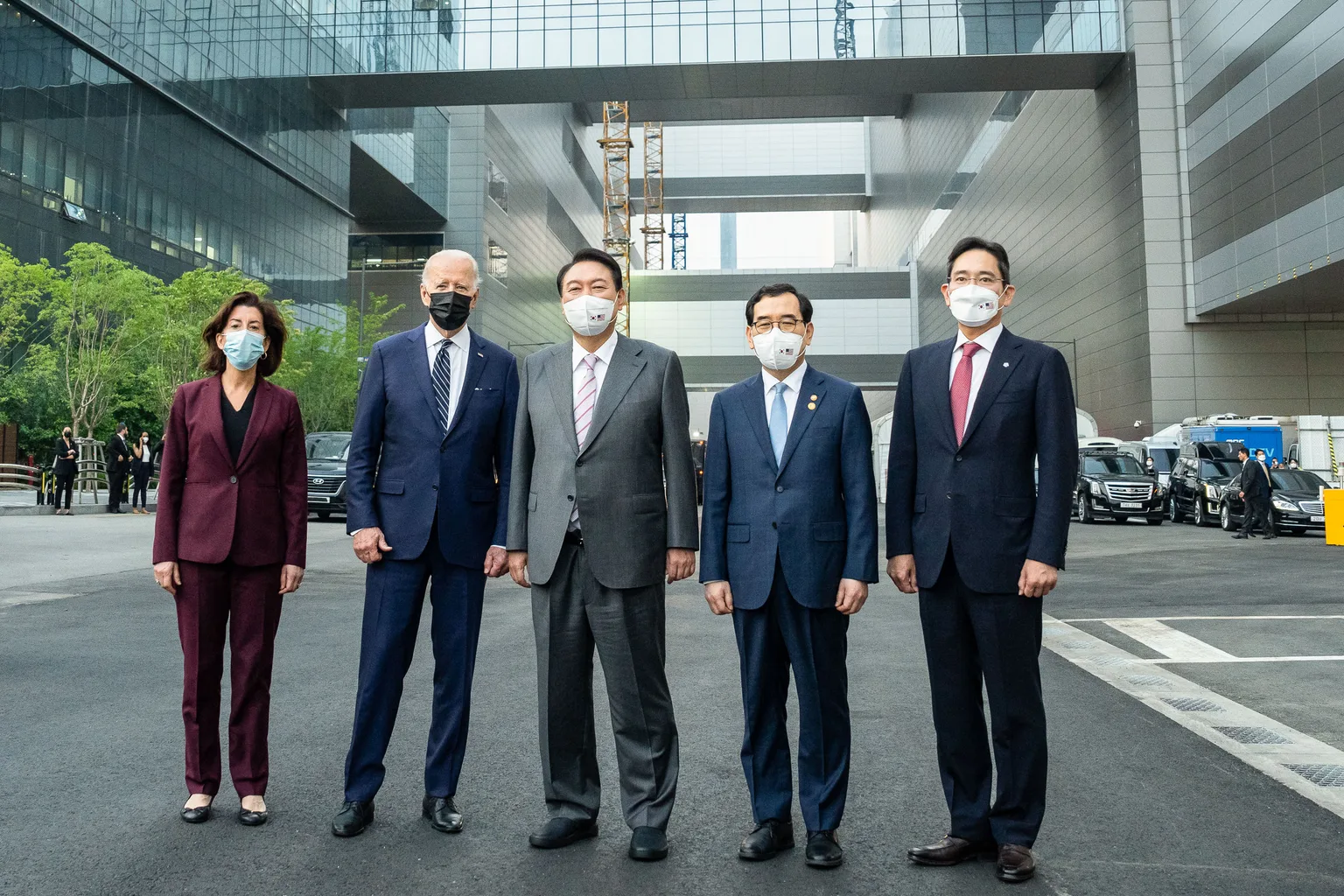
Photo: The White House, public domain, via Wikimedia Commons
The Korean semiconductor supercycle that began in 2024 came from two forces at once: demand for high-bandwidth memory (HBM) in AI servers, and a surge in prices for commodity memory. Add hopes that Commercial Act reform and the "Value-up" program would shrink the discount on Korean stocks, and both earnings and share prices pushed past their old peaks.
The path was not smooth. Samsung Electronics hit a crisis in November 2024, with its stock falling to 49,900 won, and SK hynix lost more than half its value within about a month of its June 2026 peak. Part 2 covers what HBM changed, how Samsung turned around from the bottom, what the Commercial Act reform did, and why the PBR band from Part 1 failed this time, using reported results. Prices and index levels are Korea Exchange closes as of October 8, 2026.
Korean Chip Supercycle series. This is Part 2. Part 1 covered the structure of the memory cycle, the attempts to sell Hynix, and PBR-band trading.
What Is HBM and Why Did It Change the Game?
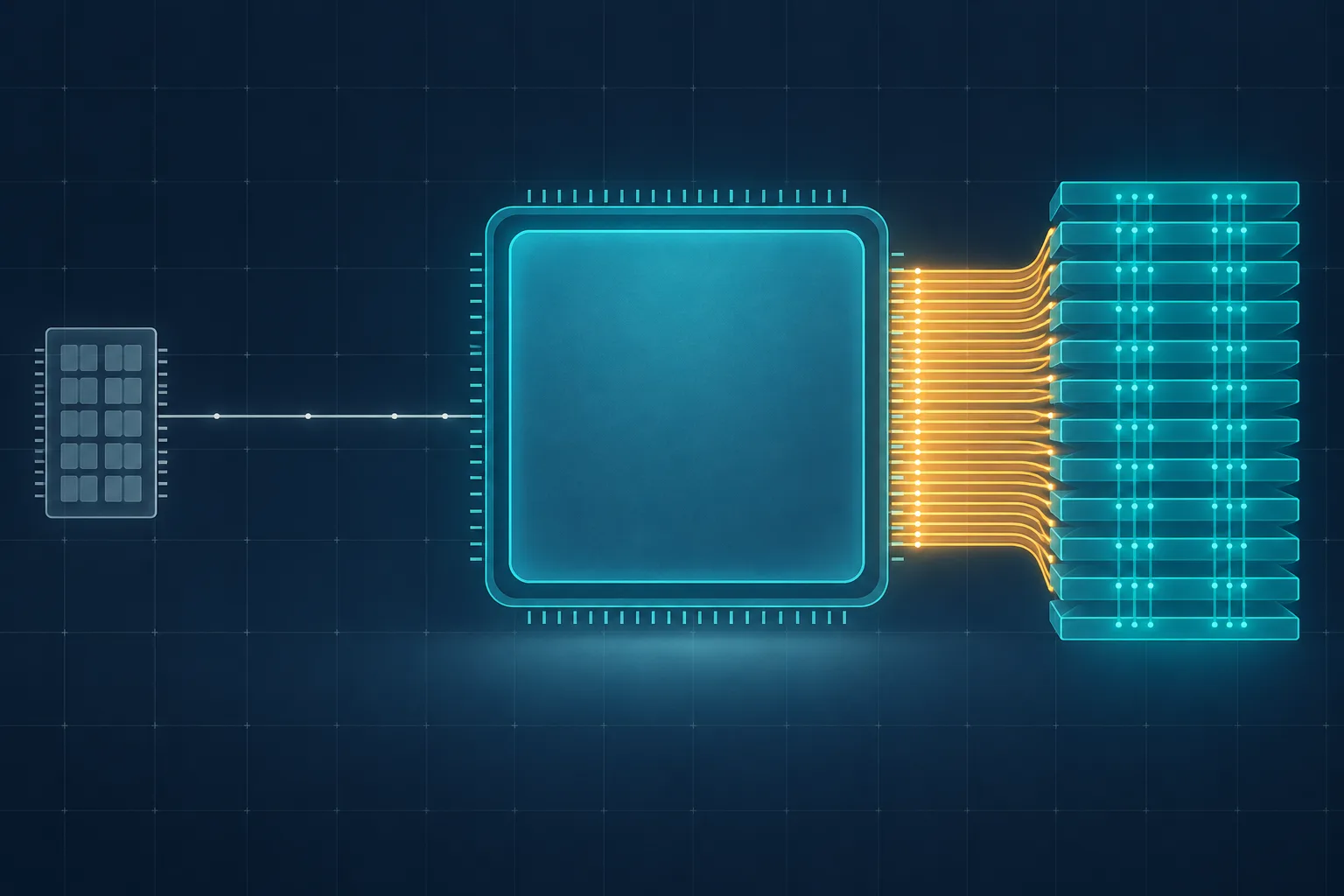
HBM stacks several DRAM dies vertically and links them with through-silicon connections, so that a large amount of data can move at once right next to an AI accelerator. Unlike commodity DRAM, it has to be designed and qualified for each customer's accelerator, so once a supply relationship is set it does not change easily.
SK hynix developed the world's first HBM with AMD in 2013 and in 2022 began mass-producing HBM3 for Nvidia's H100. The market was small and not very profitable at first, but when generative AI drove a surge in demand for Nvidia accelerators, SK hynix was the supplier that was ready. According to Counterpoint Research, HBM bit-shipment shares in Q2 2025 were 62% for SK hynix, 21% for Micron and 17% for Samsung.
Samsung was late. Korean industry reports say Samsung disbanded its dedicated HBM team around 2019, judging demand and profitability too low, and rebuilt it in 2024. The company has not confirmed this.
The contract model mattered too. KB Securities analyst Kim Dong-won, quoted by Asia Economy in August 2026, estimated that five-year supply agreements with hyperscalers had locked in more than 60% of memory output. Part of a business whose prices once moved almost like a spot commodity had become a long-term contract business.
The Lesser-Known Story: The Company Nearly Sold to Micron Overtook Samsung
As Part 1 showed, Hynix came close to being sold to Micron in 2002. Twenty-three years later it overtook Samsung, the long-time memory leader.
The first milestone was DRAM revenue. Counterpoint Research put Q1 2025 DRAM revenue shares at 36% for SK hynix, 34% for Samsung and 25% for Micron, the first time in 33 years that Samsung was not No. 1, according to Korea JoongAng Daily. The second was annual profit. SK hynix's 2025 operating profit of 47.21 trillion won (on revenue of 97.15 trillion won, a 49% margin) exceeded Samsung Electronics' company-wide operating profit of about 43.5 trillion won for the first time on a full-year basis.
SK hynix quarterly results (K-IFRS, consolidated). Sources: SK hynix Newsroom, Newsis
In Part 1's table, SK hynix lost 7.73 trillion won at the operating level in 2023 alone. Less than three years later it earned more than 60 trillion won in a single quarter. That gap is the size of this cycle.
The Lesser-Known Story: Samsung at the Bottom and the Tesla Contract
Samsung's 2024 went the other way. Reuters reported in May 2024 that Samsung's HBM had failed Nvidia's tests because of heat and power consumption problems; Samsung denied it. On October 8, alongside preliminary Q3 results showing 9.1 trillion won of operating profit, chip division head Jun Young-hyun issued an unusual public apology and pledged to restore the company's "fundamental technological competitiveness."
The stock and the flows hit bottom too. Foreign investors were net sellers of Samsung for 33 straight trading days from September 3 to October 25, 2024, reported as a record. The stock first closed below 1x book on October 25, and on November 14 it closed at 49,900 won, its lowest close since June 2020, taking its market value below 300 trillion won. The next day Samsung's board approved a 10 trillion won buyback over one year, and the first 3 trillion won of shares were cancelled in February 2025.
The Tesla contract is often cited as the turning point. On July 28, 2025, Samsung disclosed a foundry supply contract worth 22.76 trillion won (about $16.5 billion). It did not name the customer at first, but Elon Musk posted on X that Samsung's new Texas fab would make Tesla's next-generation AI6 chip and added that $16.5 billion was "the bare minimum." The contract runs through the end of 2033. Samsung shares closed up 6.83% at 70,400 won that day, their first close above 70,000 won in about 11 months.
The Tesla deal did not drive Samsung's profits directly, though. It is foundry revenue spread over the years to 2033, and most of the record 2026 profit came from memory: of Samsung's 57.2 trillion won of operating profit in Q1 2026, the chip (DS) division earned 53.7 trillion won. The Tesla contract changed how the market saw Samsung, as a sign that big customers would come to its foundry too. The profit turnaround itself came afterward from the memory price surge and rising HBM supply. Samsung announced that it had begun mass-production shipments of HBM4 in February 2026.
Chart data
Chart summary: Samsung Electronics (005930) daily candles, 2024-07-01 to 2026-10-08. Close 81,800 KRW → 263,000 KRW (+221.5%); period high 374,500 (2026-06-19), low 49,900 (2024-11-14). Marked: Close 49,900 2024-11-14 close 49,900, Tesla deal 2025-07-28 close 70,400, Tops 100,000 2025-10-27 close 102,000, 2,000T mkt cap 2026-06-01 close 349,000.
How to Interpret the Supercycle in Numbers
The cycle's second driver was commodity memory prices. As AI servers absorbed HBM and high-capacity DRAM, supply for PC and mobile parts tightened. TrendForce forecast that conventional DRAM contract prices would rise 90-95% quarter on quarter in Q1 2026 and NAND 55-60%, both record increases. The pace has since slowed: TrendForce's Q4 2026 forecast is 10-15% for conventional DRAM and 15-20% for NAND.
Samsung Electronics quarterly results (consolidated). Sources: Samsung Newsroom, Seoul Economic Daily (Q3 2026 preliminary)
Samsung's preliminary Q3 2026 operating profit of 107.4 trillion won was the first quarter above 100 trillion won for any Korean company. Yet the stock fell 2.4% on the day. The result beat the LSEG consensus (106.1 trillion won) but missed Bloomberg's (108.67 trillion won). The bigger the profits, the more the market reacts to the gap against expectations rather than to the result itself.
Brokerage views flipped fast. In September 2024 Morgan Stanley's "Winter Looms" report cut SK hynix two notches to Underweight and its target from 260,000 won to 120,000 won. A year later, in September 2025, its "Memory Supercycle" report raised the stock to Overweight with a 410,000 won target. On October 8, 2026, SK hynix closed at 1,686,000 won.
Commercial Act Reform and Value-up: Tools Aimed at the Korea Discount
Separately from chip earnings, Korea changed rules aimed at how the whole market is valued. The Financial Services Commission announced its corporate Value-up program on February 26, 2024, and the National Assembly amended the Commercial Act three times in 2025-2026.
Separate taxation of dividend income also applies to dividends paid from 2026, as a three-year temporary measure. It covers companies with a payout ratio of at least 40%, or at least 25% with dividends up 10% or more, and the top rate is 30%. Hoarding treasury shares without cancelling them, and directors owing no duty to shareholders when decisions favored controlling families, had long been cited as reasons Korean stocks traded cheaply. The amendments try to change those conditions in law.
The market responded. The KOSPI first closed above 4,000 on October 27, 2025, at 4,042.83, and topped 9,000 on June 18, 2026, closing at 9,063.84. That same month, however, MSCI declined to put Korea on its developed-market watch list, citing the won's limited offshore trading, short-selling oversight and omnibus account issues. The reforms have not removed every source of the discount.
Reliable vs. Risky Readings: Why the PBR Band Failed This Time
Under Part 1's PBR band, selling SK hynix near 2x book was the historical rule. This cycle went far past that line. In November 2025, SK Securities said the stock had broken above the top of its historical PBR band, switched its SK hynix valuation to PER, and set a 1,000,000 won target at 11 times next year's earnings per share. According to a Money Today Broadcasting tally, 22 of 25 brokerages still used PBR in early February 2026, but the multiples they applied had risen from 2.0-2.8x in the first half of 2025 to 3.5-3.9x.
Two arguments explain why the band broke. One is that long-term HBM contracts reduced earnings volatility. The other is that earnings grew so fast that book value could not keep up. Applying loss-era book multiples to a company earning more than 60 trillion won a quarter is hard to justify.
Chart data
Chart summary: SK hynix (000660) daily candles, 2025-01-02 to 2026-10-08. Close 171,200 KRW → 1,686,000 KRW (+884.8%); period high 2,987,000 (2026-06-25), low 162,700 (2025-04-09). Marked: Close 535,000 2025-10-27 close 535,000, Tops 1M won 2026-02-24 close 1,005,000, Intraday peak 2026-06-25 close 2,917,000, -56% from peak 2026-07-30 close 1,322,000.
PER was not the answer either. SK hynix hit an intraday high of 2,987,000 won on June 25, 2026, and on July 30, right after reporting record Q2 operating profit of 60.54 trillion won, it closed at 1,322,000 won, 55.7% below the peak. Its PER at that point was about 4.5x, the same shape as the 2018 "PER trap" described in Part 1. Just before that, on July 28, the KOSPI fell 10.84% in a day, and on July 29 circuit breakers were triggered for a second straight session.
What broke this cycle, in other words, was the number "sell at 2x book," not the cyclical tendency for shares to turn first when earnings look close to a peak. In August 2026 Mirae Asset Securities estimated SK hynix's 12-month forward PBR at 1.8x and its PER at 3.5x, back to "pre-AI-boom levels." The band's numbers can change, but once the market starts doubting how long earnings will last, multiples compress fast.
Limitations and Risks
How index concentration and leveraged products amplify volatility is covered in a separate post on KOSPI volatility and single-stock leveraged products. With weights this large, a turn in the chip cycle moves the whole KOSPI in the same direction.
| Stock | 2025 operating profit | Q2 2026 operating profit | Close on Oct 8, 2026 |
|---|---|---|---|
| Samsung Electronics005930 | About 43.5 trillion won | 89.5 trillion won | 263,000 won |
| SK hynix000660 | 47.21 trillion won | 60.54 trillion won | 1,686,000 won |


A Checklist Before Acting
- Is memory price growth accelerating or slowing?
- When reading results, did you compare them with consensus as well as with past quarters?
- Can you explain how the PBR or PER multiple you are applying differs from the historical band, and why?
- Are there signs of change in HBM supply contracts or customers' capex plans?
- When do the Commercial Act changes take effect, and have your holdings actually changed their treasury share or dividend policy?
- Are you exposed to the same chip cycle twice, through individual stocks and through index or leveraged products?
Frequently Asked Questions
How is HBM different from regular DRAM?
HBM is DRAM, but it is a high-performance product made by stacking several dies vertically and placing them right next to an AI accelerator. It has to be designed and qualified for the customer's chip, so a large share is sold under long-term contracts.
Regular DRAM is a standardized commodity whose price can change sharply each quarter with supply and demand. In this cycle, capacity shifting to HBM also pushed regular DRAM prices up.
What is Korea's "3% rule" in the Commercial Act?
When audit committee members are elected, the largest shareholder may vote no more than 3% of shares, counting its affiliates together. The first amendment extended this combined cap to the election of outside directors who sit on the audit committee, effective July 23, 2026.
The aim is to stop a controlling shareholder from effectively choosing the people who oversee management on its own.
Key Takeaways
- This supercycle combined HBM demand from AI accelerators with a surge in commodity memory prices, and part of the memory business moved to long-term contracts.
- Hynix, nearly sold in 2002, overtook Samsung in DRAM revenue and in full-year operating profit for the first time in 2025.
- Samsung fell to a 49,900 won close in November 2024; the July 2025 Tesla contract is seen as the turning point, but most of the profit rebound came from memory.
- Three Commercial Act amendments and separate dividend taxation target the Korea discount, but MSCI still did not add Korea to its developed-market watch list in 2026.
- The old "2x book" number broke, but the July 2026 sell-off confirmed that shares still turn first when the market suspects an earnings peak.
References
- Counterpoint Research, Q1 2025 DRAM market share (Korea JoongAng Daily), April 2025
- DIGITIMES, Q2 2025 HBM share (citing Counterpoint), Sep 25, 2025
- Korea JoongAng Daily, How HBM split the paths of Samsung, AMD and SK hynix
- Dealsite, report on Samsung's HBM organization (Korean)
- Herald Economy, SK hynix 2025 results top Samsung, Jan 28, 2026 (Korean)
- SK hynix Newsroom, Q1 2026 results and Q2 2026 results
- Newsis, SK hynix down 56% from its peak, Jul 30, 2026 (Korean)
- Seoul Shinmun, Jun Young-hyun's apology, Oct 9, 2024 (Korean)
- Financial News, Samsung below 1x book and foreign selling streak, Nov 13, 2024 (Korean)
- Daum (Yonhap), Samsung's 10 trillion won buyback, Nov 15, 2024 (Korean)
- Weekly Kyunghyang, Samsung's 22.8 trillion won foundry contract, Jul 28, 2025 (Korean)
- Samsung Newsroom, Q4 and FY2025 results and Q1 2026 results
- Seoul Economic Daily, Samsung's 107 trillion won quarterly profit, Oct 8, 2026
- Money Today, Samsung begins HBM4 mass-production shipments, Feb 12, 2026 (Korean)
- TrendForce, 1Q26 DRAM and NAND price forecast, Feb 2, 2026, and 4Q26 forecast, Sep 30, 2026
- KED Global, Morgan Stanley "Winter Looms", Sep 19, 2024
- Korea JoongAng Daily, Morgan Stanley "Memory Supercycle", September 2025
- Yulchon, 2025 Commercial Act amendments (Korean)
- CEO Score Daily, second Commercial Act amendment passes, Aug 25, 2025 (Korean)
- Newspim, third Commercial Act amendment passes, Feb 25, 2026 (Korean)
- SBS Biz, separate taxation of dividend income passes, December 2025 (Korean)
- Newsis, KOSPI tops 4,000, Oct 27, 2025 (Korean)
- Herald Economy, KOSPI tops 9,000, Jun 18, 2026 (Korean)
- CNBC, MSCI keeps South Korea in emerging markets, Jun 24, 2026
- KED Global, late-July KOSPI crash and rebound, Jul 31, 2026
- Money Today Broadcasting (Daum), how brokerages value SK hynix, Feb 3, 2026 (Korean)
- Korea Economic Daily, SK Securities switches to PER, Nov 3, 2025 (Korean)
- Asia Economy, Mirae Asset on SK hynix, Aug 12, 2026, and KB Securities on long-term supply agreements, Aug 17, 2026 (Korean)
- G-Enews, Samsung and SK hynix weight in the KOSPI, June 2026 (Korean)
- Newspim, October 8 market close, Oct 8, 2026 (Korean)
For reference only: The information in this post is provided for general reference and does not constitute investment advice or a solicitation to trade. Your responsibility: Final investment decisions and their outcomes are entirely your own. No warranty: This information is not guaranteed to be accurate and cannot be used as a basis for legal liability for any investment result.