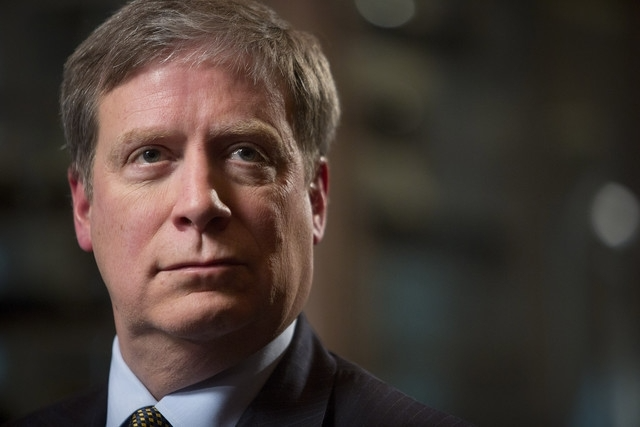
Stanley Druckenmiller (born 1953) is a macro trader who saw the core of his results less in calling market direction than in how much he put behind a call once he was right. He founded Duquesne Capital in 1981 and ran George Soros's Quantum Fund from 1988 to 2000. After closing Duquesne Capital in 2010, he now runs the Duquesne Family Office.
One fact is often left out when he comes up, however. The widely quoted record of "more than 30% a year for 30 years with no losing year" is not an audited figure. The phrase did not first appear in a statement of his own, either, but in the introduction to a 2015 talk. This post lays out his method from his own remarks and contemporary reporting, and separates what can be verified from what is merely passed along.
Part 1 of a two-part Druckenmiller series. Part 2 covers the 13F filings of the Duquesne Family Office. The man who was his mentor and colleague has a separate two-part series: Soros Part 1: Reflexivity Theory and Soros Part 2: 13F Analysis.
How He Became Head of Research at 25
Druckenmiller studied English and economics at Bowdoin College, graduating in 1975, then entered the economics PhD program at the University of Michigan and dropped out in his second semester. He joined Pittsburgh National Bank as a new hire in 1977 and became head of equity research within a year.
His own account explains why the appointment was unusual. He was 25 at the time. Most of the people reporting to him were in their late thirties and held MBAs, and he was the only one without one (Pittsburgh Quarterly interview, 2025-01-08). The man who made that decision was Speros Drelles, then head of the investment division.
Popular accounts of Druckenmiller tend to center on his relationship with Soros, but he points to a different source for his method. He describes Drelles as his first mentor and Soros as his second, and says that what Soros added was the habit of betting big when you see the opportunity (Lost Tree Club talk, 2015-01-18). In his own summary, then, the analytical framework came from Drelles and the size of the bet came from Soros.
Two Principles from Drelles
What Drelles taught comes down to two sentences. Both can be applied directly to your own trading today.
Sources: full transcript of the Lost Tree Club talk (2015-01-18); Jack Schwager, The New Market Wizards (1992).
The detail most often misquoted in the first principle is the time frame. Some summaries say "6 to 12 months ahead," but the number he repeated is 18 months. The difference looks small and is not in practice. Six months typically spans a couple of earnings seasons, while 18 months is long enough for the direction of the rate cycle to turn.
The second principle is the key to understanding his trading. Watching liquidity instead of earnings does not mean he skips analysis of individual companies. It means he locates the variable that decides the direction of the whole market elsewhere. In fact, the chapter on him in Schwager's book is titled "The Art of Top-Down Investing," and the book deliberately sets it beside Richard Driehaus's "The Art of Bottom-Up Investing."
The One Thing Soros Taught Him: Sizing
What Druckenmiller repeatedly says he learned from Soros is neither stock selection nor market judgment but position size. The original form is preserved in Schwager's 1992 interview.
"Soros has taught me that when you have tremendous conviction on a trade, you have to go for the jugular." "As far as Soros is concerned, when you're right on something, you can't own enough."
A line from the same interview is the formal statement of this philosophy: "I've learned many things from him, but perhaps the most significant is that it's not whether you're right or wrong that's important, but how much money you make when you're right and how much you lose when you're wrong." Popular quotations often present that line as Druckenmiller's own, but he says it is a lesson he learned from Soros.
The point to take from it is that this principle is not a call to "bet big." The sentence holds two conditions at once. To make a lot when you are right, you have to size up when conviction is high. To lose little when you are wrong, you have to size down when conviction is gone. Without the second condition, the same principle becomes a way to lose an account.
Sterling in 1992: A Division of Labor Between Idea and Sizing
The September 1992 sale of the British pound is known as Soros's signature trade, but the person who built the case and put on the position was Druckenmiller. Two independent sources confirm the distinction.
According to Sebastian Mallaby's More Money Than God (2010), Druckenmiller had already built a short sterling position of about $1.5 billion and suggested adding to it because it was close to paying off, and Soros replied, "Go for the jugular." Druckenmiller's own recollection in the 2015 talk tells the same scene from another angle. He said he told Soros, "George, I'm going to sell $5.5 billion worth of British pounds tonight and buy deutsche marks ... that means we'll have 100 percent of the fund in this one trade." Soros reportedly answered: "That is the most ridiculous use of money management I ever heard. What you described is an incredible one-way bet. We should have 200 percent of our net worth in this trade, not 100 percent."
The two accounts do not contradict each other. They emphasize different parts of the same conversation. In summary the division of labor looks like this.
This case matters in Part 1 because it is the only scene where his philosophy is confirmed as concrete action rather than an abstract maxim. Two people with the same information and the same argument proposed different sizes, and what made the difference in the final result was size, not analysis.
The profit from this trade needs careful handling, though. It is often quoted as "$1 billion in a day," but Quantum was an offshore private fund that did not publish audited results, and estimates range from $1 billion to $1.8 billion depending on the source. What they measure also differs: the sterling trade alone or all European currency positions, the fund or Soros personally, one day or one month. The background to the trade and the cost the UK Treasury disclosed are covered separately in Soros Part 2.
The Concentration Philosophy and Its Preconditions
Druckenmiller uses unusually strong language about diversification. In the 2015 talk he said, "I strongly believe the only way to make long-term returns in our business that are superior is by being a pig," "I think diversification and all the stuff they're teaching at business school today is probably the most misguided concept everywhere," and "if you really see it, put all your eggs in one basket and then watch the basket very carefully."
Quoted on its own, that statement makes for dangerous advice. The same talk includes the precondition.
"I was developing a philosophy that if I can look at all these different buckets and I'm going to make concentrated bets, I'd rather have a menu of assets to choose from to make my big bets and particularly since a lot of these assets go up when equities go down."
His concentration, in other words, is not cutting the number of stocks within one asset class. It is keeping stocks, bonds, currencies and commodities all as candidates and putting a large weight on the one with the highest conviction. Because the choice set is wide, he can carry individual bets large.
This is where an individual investor's situation differs. The asset classes most individuals can reach are narrower, and it is harder to add assets that rise when stocks fall at low cost. Raise concentration alone with a narrow choice set, and you take on the part of his philosophy that adds risk while leaving out the part that offset it.
2000: How the Same Philosophy Failed
Druckenmiller's tech-stock losses are often folded into one event in summaries, but they were really two separate failures. Going by his own 2015 account, they split like this.
Contemporary reporting by Forbes (2000-04-28) said Quantum was down 19.4% year to date as of April 20, 2000, with net assets of about $6 billion. The same fund returned 35% in 1999. He left Soros Fund Management in April 2000.
This case is needed for the conclusion of Part 1 because the cause of failure was not the absence of the philosophy but a failure to follow its second condition. Under "big when right, small when wrong," he sized big both times, and the second time he sized big after reversing direction altogether. In his own telling, he had committed far too much to the bet.
How Solid Is the Famous Track Record?
"More than 30% a year for 30 years, no losing year" circulates as fact, but this is as far as it can be confirmed.
- The closest source for the phrase is the introduction given by Sam Reeves at the Lost Tree Club talk on January 18, 2015: "if he invested $1,000 30 years ago, today it would be $2.6 million before taxes ... Thirty years, no losses." For $1,000 to become $2.6 million over 30 years requires a compound annual return of about 29.97%, so the number is internally consistent.
- Bloomberg's account (2010-08-18) uses a different period. It reported returns that "had averaged 30 percent annually since 1986," which as of 2010 is a 24-year span, not 30 years.
- The same report says Duquesne Capital closed in 2010 managing about $12 billion and that its performance in the year it closed was a 5% loss. So the no-loss record holds on completed calendar years, and he shut the fund in a year when it was down.
There is no public source such as GIPS-verified data, an audit report or a regulatory filing that confirms this return. That is not evidence against his skill. It is a question of what kind of source backs up the long-term record of a private fund. The habit of separating what is audited from what is reported applies directly when you read performance claims for private products or advisory services.
Checkpoints for Investors
- Did you record whether your reason for entering is current earnings or conditions expected to differ 12 to 18 months out?
- Apart from the stock call, did you write down liquidity conditions such as rates, monetary policy and money flows?
- What was the basis for judging your conviction as high, and did you set size in proportion to it?
- Before entering, did you set the conditions for cutting size when conviction weakens?
- When you carry a concentrated position, is it one chosen from a wide set of options, or is it the only option?
- Is the performance figure you are relying on audited, or is it a reported or hearsay estimate?
Frequently Asked Questions
Q1. Is it true that Druckenmiller never had a losing year in 30 years?
It cannot be verified from public sources. The claim spread from the introduction to a 2015 talk, and there is no audit report or regulatory filing that confirms it.
The Bloomberg report also dates the 30% annual average from 1986, and Duquesne Capital's performance in 2010, the year it closed, was a 5% loss. The no-loss record is best read as a statement limited to completed years.
Q2. Can individual investors apply the "all eggs in one basket" principle as is?
The concentration he described is not concentration within a narrow set of options. It is putting a large weight on one pick while stocks, bonds, currencies and commodities are all candidates. In the same talk he stated that a broad menu of assets is the precondition.
If you raise concentration while your choices are limited to a handful of stocks, the element that originally spread risk drops out and only the element that increases it remains. And he himself failed to keep the second condition of the philosophy, loss limits, in 2000, and lost about $3 billion in six weeks.
Key Takeaways
Druckenmiller is a macro trader who treated the size placed behind a call, rather than the direction call itself, as the key variable in results.
- His analytical framework came not from Soros but from his Pittsburgh mentor Speros Drelles, and its core is a lookahead of about 18 months and a liquidity-centered view of markets.
- The one thing he says he learned from Soros is position sizing.
- In the 1992 sterling trade, Druckenmiller supplied the case and the first position, and Soros decided the size.
- His concentration philosophy comes with the precondition of a wide menu of asset classes. Drop that, and you add only risk.
- The 2000 tech losses were two different events, a failed short in 1999 and a failed buy in 2000, and the cause was not the absence of the philosophy but a failure to honor its loss-limiting condition.
- "30 years without a loss, 30% a year" is not an audited record but a description based on a talk's introduction and press reports.
What an individual investor can take from his approach is not the concentration itself but the habit of recording, every time, the basis for conviction, the size in proportion to it, and the conditions for cutting back when conviction is gone. How closely his actual positions match these principles is checked in Part 2's 13F analysis.
References
- Stanley Druckenmiller, full transcript of the Lost Tree Club talk (2015-01-18)
- Jack D. Schwager, The New Market Wizards, HarperBusiness, 1992
- Sebastian Mallaby, More Money Than God: Hedge Funds and the Making of a New Elite, Penguin Press, 2010
- Jeff Sewald, "What Do I Know? Stanley Druckenmiller", Pittsburgh Quarterly (2025-01-08)
- Forbes, "Soros Funds Hit Hard By Druckenmiller's Departure" (2000-04-28)
- Bloomberg, "Druckenmiller Calls It Quits After 30 Years" (2010-08-18)
- Morgan Stanley, "Hard Lessons: Stan Druckenmiller — Invest, then investigate" (recorded 2026-01-30, published 2026-02-27)
For reference only: The information in this post is provided for general reference and does not constitute investment advice or a solicitation to trade. Your responsibility: Final investment decisions and their outcomes are entirely your own. No warranty: This information is not guaranteed to be accurate and cannot be used as a basis for legal liability for any investment result.