
At the center of George Soros's investment philosophy (born 1930) is reflexivity. The claim is that market participants' perceptions move prices, and that those prices then change the very fundamentals the participants were trying to judge.
Reflexivity is often boiled down to "sentiment moves markets," but Soros's argument targets causal structure, not sentiment. Because cause and effect loop back on each other, neither can serve as an independent variable, and so the idea of an equilibrium price stops making sense. This post works through the argument step by step, using his own papers and lectures, and also covers the criticisms the theory has drawn and the limits he admitted himself.
Part 1 of a two-part Soros series. Part 2 covers the 13F filings of Soros Fund Management. The man who actually ran his Quantum Fund from 1988 to 2000 has a separate two-part series: Druckenmiller Part 1 and Druckenmiller Part 2.
From Philosophy to the Market
Soros was born in Budapest in 1930. From 1944 to 1945 he survived the Nazi occupation on forged identity papers. After Hungary turned communist in 1947 he moved to London, where he worked as a railway porter and a nightclub waiter while attending the London School of Economics (LSE), according to his official biography.
At LSE he came across the ideas of Karl Popper. Popular accounts tend to exaggerate this part, so two points are worth separating.
First, it is hard to call Popper his official academic supervisor. The clearest evidence is Soros's own account. After he sat his exams early and was allowed to choose a supervisor, he said, "I could choose my tutor and I chose Karl Popper." That describes a relationship he picked himself, not a supervisory relationship on the university's records.
Second, The Burden of Consciousness was not a thesis that failed review but an unpublished manuscript. It was a book he worked on for several years in the early 1960s. He sent it to Popper, got a favorable reply, and that led to their meeting. Soros later judged that the manuscript mostly repeated Popper's ideas.
He took two things from Popper. One is fallibilism, the view that human knowledge is inherently incomplete. The other is the Oedipus effect, the idea that a prediction can change the thing it predicts. Reflexivity is what you get when you apply both to financial markets. In other words, his view of markets was not drawn inductively from the market. It came down deductively from philosophy and was then tested in the market.
The Two Propositions of Reflexivity
Soros's most precise statement of his theory is "Fallibility, reflexivity, and the human uncertainty principle," published in the Journal of Economic Methodology in 2013. There he presents the theory as two propositions.
First, fallibility.
"The first is that in situations that have thinking participants, the participants' views of the world never perfectly correspond to the actual state of affairs. People can gain knowledge of individual facts, but when it comes to formulating theories or forming an overall view, their perspective is bound to be either biased or inconsistent or both."
Second, reflexivity.
"The second proposition is that these imperfect views can influence the situation to which they relate through the actions of the participants."
The first proposition alone is nothing new. Behavioral economics already covers the point that people get things wrong. Soros's argument parts ways with it at the second proposition: a wrong view does not stay wrong and inert; actions based on it actually change the situation it was about.
How the Cognitive and Manipulative Functions Interfere
The core of the reflexivity argument is the passage below. Skip it and reflexivity shrinks to the familiar line that "expectations create reality."
"One is to understand the world in which we live; I call this the cognitive function. The other is to make an impact on the world and to advance the participants' interests; I call this the manipulative function."
"When both the cognitive and manipulative functions operate at the same time they may interfere with each other. How? By depriving each function of the independent variable that would be needed to determine the value of the dependent variable."
Unpacked, it works like this. In the cognitive function, the situation is the independent variable and the participant's perception is the dependent one, because reality should determine what I think. In the manipulative function the roles flip: perception is the independent variable and the situation is the dependent one, because my actions based on my judgment change reality.
The problem is that in a market the two operate at the same time. When the situation determines perception while perception also determines the situation, neither is a fixed reference point. Without an independent variable, the dependent variable has no determined value either. Soros's conclusion is not that markets are irrational. It is that the causal structure of markets is circular and therefore indeterminate.
He calls fallibility and reflexivity together the human uncertainty principle. Reflexivity, he writes, "introduces an element of uncertainty both into the agents' view of the world and into the world in which they participate."

How Reflexivity Differs from the Efficient Market Hypothesis
A side-by-side table makes clear what reflexivity actually claims.
In his 2009 lectures at Central European University (CEU), Soros compressed this into two propositions. Market prices always distort the fundamentals they are supposed to reflect, and financial markets actively affect the fundamentals they are supposed to reflect.
He criticizes mainstream economics for building its assumptions out of a desire to imitate physics rather than to describe reality. In the 2013 paper he wrote: "In this regard, economic theory resembles Euclidian geometry. But Euclid's postulates are modeled on conditions prevailing in the real world while at least some of the postulates of economics, notably rational choice and rational expectations, are dictated by the desire to imitate Newtonian physics rather than real-world evidence."
The Boom-Bust Model: How a Bubble Unfolds
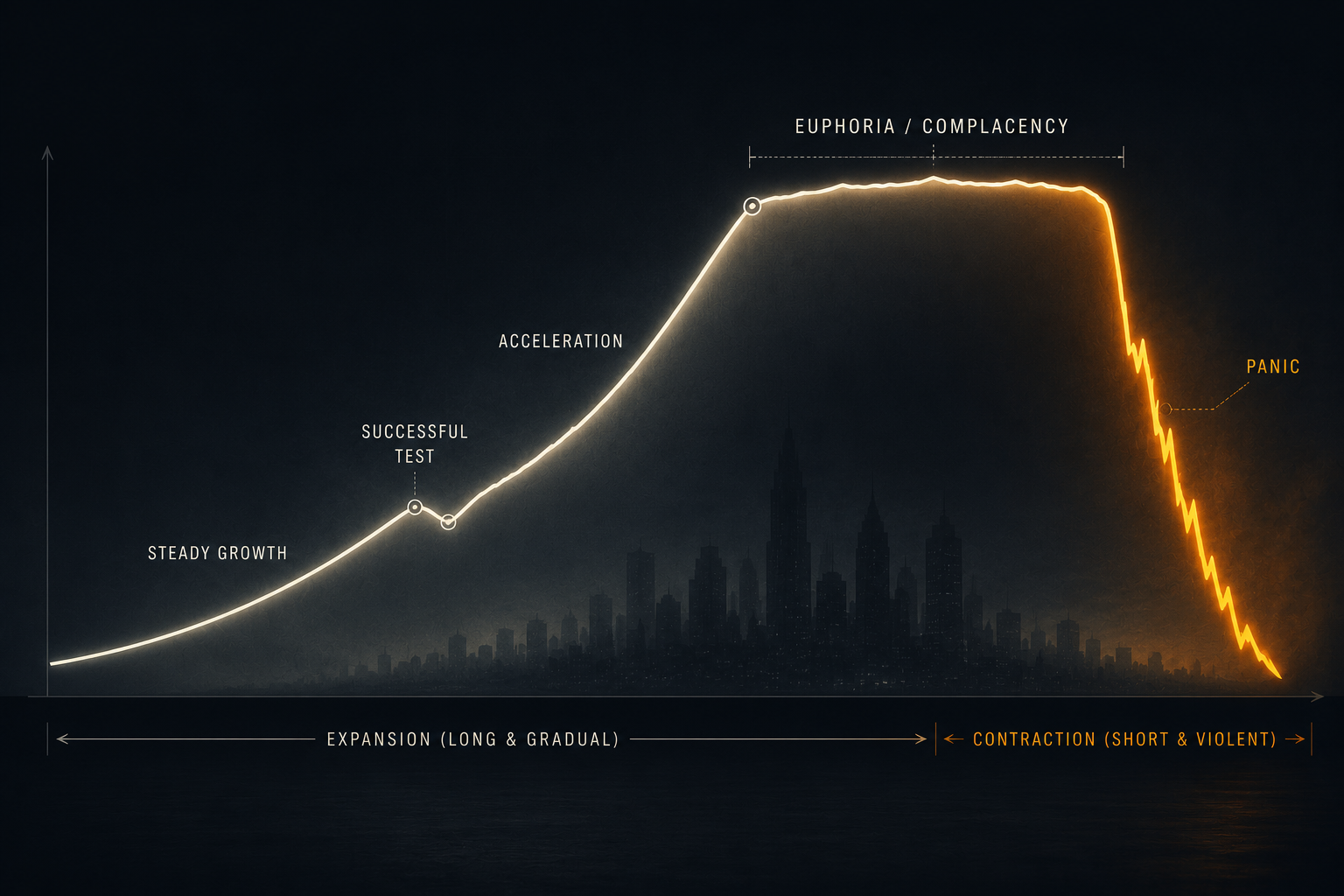
Where reflexivity earns its keep in practice is in breaking the life of a bubble into stages. Soros defines it this way: "Every bubble has two components: an underlying trend that prevails in reality and a misconception relating to that trend." A bubble is not built from a false story alone. It takes a misconception layered on top of a real trend.
The stages he lays out are as follows.
The most important practical feature of this model is its asymmetry. The rise is long and gradual and flattens out in the twilight period, while the fall is short and violent. Stage 3, the "successful test" Soros stresses, also carries real weight in practice. Living through a correction and watching the trend recover does not shake participants' conviction. It builds it, and positions in the next phase get bigger as a result. The experience of surviving the pullback becomes part of what drives the size of later losses.
One caution: the model does not tell you when. Which stage you are in usually becomes clear only after it has passed, and stages 6 and 7 are hard to tell apart in real time. The model is closer to a language for describing the current phase than an entry signal.
Examples Soros Himself Cited
Reflexivity can sound abstract, but Soros explains it with cases he observed and traded himself.
The conglomerate boom of the late 1960s and the real estate investment trust (REIT) boom of the early 1970s are the two examples he cites most often. In both, a channel he called "equity leveraging" was at work. When a stock trades above book value, the company can issue shares at that high price to raise money. If it uses the proceeds for acquisitions or asset purchases, earnings per share actually improve. The improved results look like after-the-fact proof that the inflated expectations were justified. A misconception ends up producing its own supporting evidence.
The Alchemy of Finance includes the research report he wrote at the time, "The Case for Mortgage Trusts." In it he expected both the rise and the collapse that followed, and he notes that the report was copied so widely that his own analysis became part of the reflexive process.
For the 2008 crisis he uses the concept of a super-bubble rather than an individual bubble. He describes the super-bubble as having three components: a credit expansion trend lasting roughly 25 years, the globalization of financial markets, and an acceleration of deregulation and financial innovation. The reflexive core here lies in the authorities' own interventions. "The intervention of the authorities to deal with periodic financial crises," he argues, "played a crucial role in the development of a 'super-bubble' that burst in 2007-2008." Each time a small crisis was successfully rescued, that success justified further risk-taking, and the problem was carried forward at a larger scale.
The Real-Time Experiment and Its Limits
Soros once tried to test his theory in the Popperian way. This was the Real-Time Experiment in Part 3 of The Alchemy of Finance, a journal from August 1985 to November 1986 in which he recorded the thinking behind his investment decisions before the results were known. The period includes the dollar's decline after the Plaza Accord and the oil price collapse in early 1986.
"To engage in the real-time experiment I had to go back to active management of the fund. The experiment held my attention and the fund exceeded its previous performance."
The design has a methodological problem, though. Publishing the predictions in advance gives it the form of falsifiability, but a profitable outcome alone cannot separate "the theory was right" from "the trader was good." The widely quoted "more than 100% return over this period" has weak support, so it is more accurate to read it at the level of Soros's own words: "the fund exceeded its previous performance."
Criticisms of Reflexivity
The theory has been taken seriously in academia, but the reception has not been warm. The main critiques are below.
What the three critiques share is not that reflexivity is wrong but that it is not a falsifiable theory. Reflexivity does not specify when a feedback loop starts, how strong it is, or when it reverses, so it produces no testable predictions. The charge is that it is a lens, not a model.
It is worth noting that Soros himself acknowledged this limit. He wrote that reflexivity does not meet the standards of scientific theory in current use, and argued that either the standards should be revised or financial markets should be studied in a non-scientific way. He also conceded that he did not discover reflexivity. Similar ideas already appear in Keynes's beauty contest analogy (General Theory, Chapter 12, 1936), Robert Merton's self-fulfilling prophecy (1948) and Popper's Oedipus effect.
There have been attempts to formalize it. Roman Frydman and Michael Goldberg's Imperfect Knowledge Economics (Princeton University Press, 2007) proposed a middle ground: identifying trends without quantifying them, and identifying changes in trends without specifying when. Soros cited it approvingly. In 2013, Volume 20, Issue 4 of the Journal of Economic Methodology ran a special issue on reflexivity in which 18 scholars responded to Soros's paper. The issue was later collected into a book edited by John Davis and D. Wade Hands.
The Gap Between Theory and Actual Trading
The last thing to cover is how Soros himself assessed the relationship between this theory and his results. In the new introduction to the 2003 edition of The Alchemy of Finance he writes:
"I have no doubt that my experiences as an adolescent played a major role in my subsequent success as a hedge fund manager. So did my conceptual framework."
The 2013 paper also has a passage on where the method works and where it does not.
"I can therefore compare my own expectations with prevailing prices. When I see a divergence, I see a profit opportunity. The bigger the divergence, the bigger the opportunity." "This works well in markets that are efficient in the sense that transaction costs are minimal; it does not work in private equity investments that are not readily marketable. My performance record bears this out."
There is also skeptical testimony about how much the theory drove his actual judgment. Soros himself suffered from back pain and has said he treated it as "a warning sign that something was wrong in the portfolio." Michael Kaufman's 2002 biography includes a passage in which his son says that what actually prompted his father to change positions was closer to a physical signal than to theory. That is a family member's impression, not evidence against the theory. Still, it is worth remembering that a gap can open between an elaborate theory and what happens at execution.
Tracing Reflexivity in the Korean Market
To judge whether reflexivity is useful, you have to turn it into paths you can observe. The equity leveraging Soros described shows up in a form that can be traced through filings, and the example below uses Korea's disclosure system. The same two checks can be run on US names through SEC filings on offerings and convertible issuance and through FINRA's margin debt statistics.
The upward reflexive path runs like this: share price rises → company can issue new shares or convertible bonds at the high price → proceeds fund capacity or acquisitions → revenue and earnings improve → the bullish case looks confirmed after the fact. The checkpoint is not the earnings themselves but where the money behind the improvement came from. Whether it was cash earned from operations or capital that was available only because the price was high changes how durable those earnings are. Rights offerings and convertible bond issues can be checked in the Financial Supervisory Service's electronic disclosure system (DART).
The downward reflexive path is faster: share price falls → margin loan collateral falls short → forced liquidation → further decline → larger collateral shortfalls. This path runs mechanically regardless of what participants think, which is why the boom-bust model's asymmetry shows up so sharply in the Korean market. Margin loan balances are available from Korea Financial Investment Association statistics, and the margin ratio for an individual stock can be seen on brokerage screens.
It is more realistic to use reflexivity as a checklist item than as a buy signal. It is a way to ask whether the earnings improvement you are looking at is a result of the price rise, and whether your conviction grew because of new facts or because you sat through a pullback. Those questions need to go into your trade log so you can check your answers later.
Checkpoints for Investors
- Did the earnings improvement you are relying on come from operating cash flow, or from financing that was possible only because the share price was high?
- Have you checked whether the stock recently had a rights offering or convertible bond issue, and at what price it was issued?
- Did your conviction strengthen because of a new fact, or because you sat through a pullback?
- Where in the eight boom-bust stages do you think the market is now, and did you write down the basis for that call?
- Have you checked whether the stock's margin loan ratio is high enough to trigger forced liquidation on a decline?
- Are you using reflexivity as an entry signal? Have you accounted for the fact that the model does not tell you timing?
Frequently Asked Questions
Q1. Is reflexivity the same thing as behavioral finance?
No. Behavioral finance explains why participants' perceptions are wrong through biases and heuristics, and it assumes the correct value itself is fixed. A bias is an error measured against that value.
Reflexivity goes one step further. Because actions based on wrong perceptions change the fundamentals themselves, it argues there is no fixed reference value against which to measure the deviation. In Soros's words, each function deprives the other of its independent variable. The difference is that this is a problem of causal structure, not of bias.
Q2. Can reflexivity tell you where a bubble will peak?
No. That is exactly where the theory draws its most consistent criticism. Reflexivity does not specify when feedback starts, how strong it is or when it reverses, so it cannot produce testable predictions.
Soros himself admitted that reflexivity does not meet the standard of a scientific theory in current use. In practice it is better used not as a tool for timing the market but as a language for describing the current phase and for checking where your own conviction came from.
Key Takeaways
Reflexivity is the claim that participants' imperfect perceptions change the fundamentals through their actions, which makes market causation circular.
- The theory has two propositions: fallibility, meaning perception never fully matches reality, and reflexivity, meaning those imperfect perceptions change reality.
- The core argument is about structure, not psychology. When the cognitive and manipulative functions run at the same time, each deprives the other of its independent variable, so an equilibrium price has no stable reference point.
- A bubble forms when a misconception is layered on a real trend, and its shape is asymmetric: a long, gradual rise and a short, violent fall.
- A "successful test," a pullback survived, builds conviction and fattens positions in the next phase.
- Lawson, Neely, Eichengreen and others criticize the theory as unfalsifiable, and Soros himself admitted it does not meet the standard of a scientific theory.
- In the Korean market, rights offering and convertible bond disclosures and margin loan balances let you check the reflexive path in both directions.
Applying reflexivity to trading does not mean picking the top. It means separating, every time, whether the evidence you are looking at is a cause of the price or a result of it, and writing that down. How the theory translated into actual positions continues in the 13F analysis in Soros Part 2.
References
- George Soros, "Fallibility, reflexivity, and the human uncertainty principle", Journal of Economic Methodology Vol. 20, Issue 4 (2013)
- George Soros, The Alchemy of Finance, 1987
- George Soros, The New Paradigm for Financial Markets: The Credit Crisis of 2008 and What It Means, 2008
- George Soros, Central European University (CEU) lectures "The General Theory of Reflexivity" and others (2009-10-26 to 10-30), Open Society Foundations transcript
- Tony Lawson, "Soros' Theory of Reflexivity: a critical comment", Revue de philosophie économique Vol. 14, No. 1 (2013)
- Barry Eichengreen, review of Soros's writings, UC Berkeley
- Roman Frydman & Michael Goldberg, Imperfect Knowledge Economics, Princeton University Press, 2007
- John Davis & D. Wade Hands (eds.), Reflexivity and Economics, Routledge
- Michael T. Kaufman, Soros: The Life and Times of a Messianic Billionaire, Knopf, 2002
- georgesoros.com, "The Life of George Soros" official biography
- Financial Supervisory Service electronic disclosure system (DART), Korea Financial Investment Association margin loan statistics
For reference only: The information in this post is provided for general reference and does not constitute investment advice or a solicitation to trade. Your responsibility: Final investment decisions and their outcomes are entirely your own. No warranty: This information is not guaranteed to be accurate and cannot be used as a basis for legal liability for any investment result.