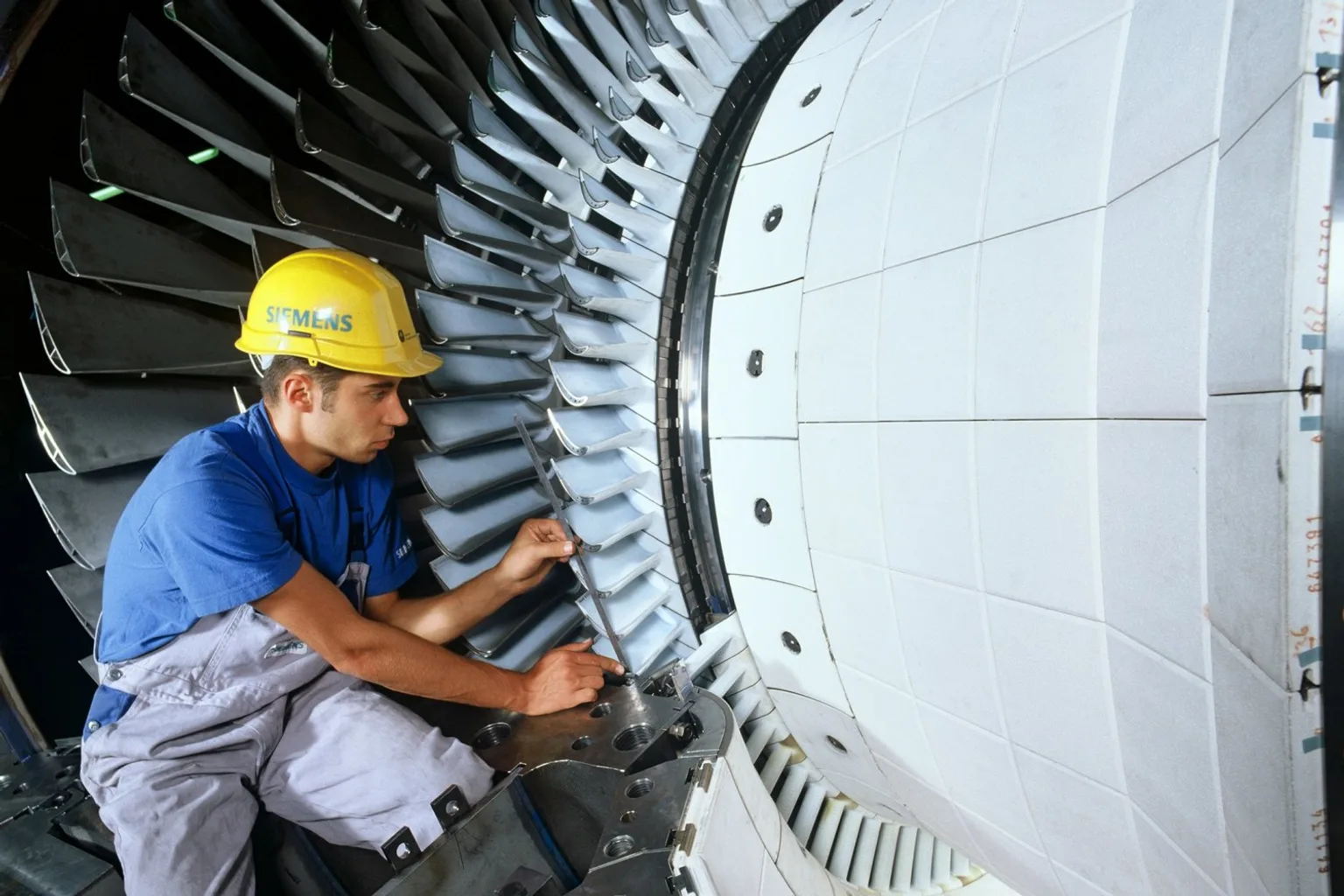
Photo: Siemens Pressebild (Siemens press photo), CC BY-SA 3.0, via Wikimedia Commons, cropped
Generation is the stage that turns energy, whether fuel, nuclear fission, wind or sunlight, into electricity. It sits at the front of the power supply chain for AI data centers. Electricity made here travels through transmission lines, substations and distribution networks before it reaches the servers.
Data centers want power in large amounts, around the clock and as soon as possible. Those conditions have pulled the market's attention to gas turbines and nuclear power over the past two years. Part 2 uses primary-source figures to show what each source does, what GE Vernova, Siemens Energy, Mitsubishi Heavy Industries and Doosan Enerbility make and how large their order books are, and how the long-term nuclear contracts Big Tech has signed are structured.
Power Is the Next Bottleneck After Nvidia series. Part 1: Why power is AI's bottleneck · Part 2: Generation (gas turbines, nuclear) · Part 3: Transformers, transmission, cables · Part 4: Distribution, data-center power, storage · Part 5: Is power a better investment than chips?
What the Generation Stage Does and Which Sources Data Centers Want
Every power plant makes electricity, but each source has a different character. Solar and wind have no fuel cost but their output changes with the weather, while gas and nuclear can deliver a set output regardless of weather. A data center runs its servers at close to the same load all year, so it needs power of the second kind.
Even among steady sources, the time it takes to build one differs widely. That gap is why orders have piled up at gas turbines.
Gas Turbines: The Fastest to Scale and the Longest Queue
A gas turbine compresses air, burns it with natural gas and uses the hot gas to spin a rotor that drives a generator. They come in two types: heavy-duty turbines for large power plants, and smaller aeroderivative units built on aircraft engines. Using the exhaust heat of a large turbine to make steam and run a steam turbine as well produces a combined-cycle plant.
The problem is that few companies and factories can build these machines. The Electric Power Research Institute (EPRI) estimated that large turbines take about five years to receive and small ones 18 to 36 months, and it said the number of places that can forge the very large components is "extremely limited" worldwide. Wood Mackenzie projected that gas turbine prices would reach $600 per kW by the end of 2027, 195% above 2019 (Utility Dive, Apr 9, 2026).
Manufacturers describe similar wait times. On its April 2026 earnings call, GE Vernova put the lead time for a new large turbine order at "about three years," but said in the same session that only about 10 GW of 2029 and 2030 production remained. Mitsubishi Power's head for Europe, the Middle East and Africa said in a July 2026 interview that delivery times have stretched from two years just after the pandemic to more than five, and that the company is now contracting deliveries for 2031-2034. NextEra CEO John Ketchum, whose company is the largest US power producer, said in June 2025 that building a new gas plant takes at least seven years.
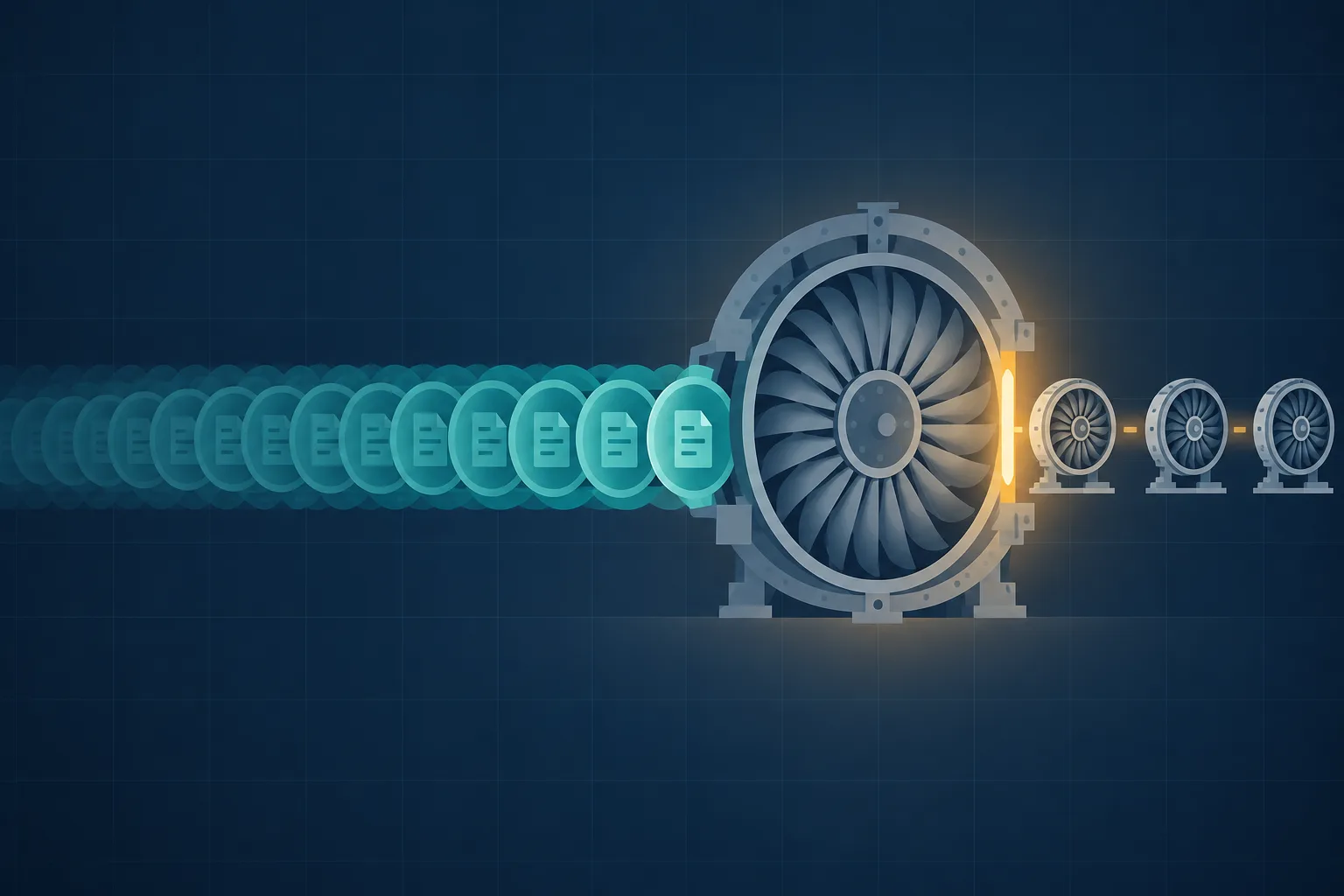
GE Vernova: The World's Largest Gas Turbine Maker Is Selling Production Slots
GE Vernova is an energy equipment company spun off from GE in April 2024. It has three segments: Power, which covers gas turbines and nuclear and hydro equipment; Electrification, which covers grid equipment such as transformers and switchgear; and Wind. AI data center demand reaches the company most directly through gas turbines in the Power segment.
One concept to note in GE Vernova's gas turbine business is the slot reservation agreement (SRA). A customer pays to hold a production slot several years out even before placing a formal order. At the end of Q2 2026, the firm order backlog was 53 GW and slot reservations were 63 GW, for a total of 116 GW. Of the 20 GW of new agreements signed in the quarter, 18 GW were slot reservations.
Source: GE Vernova Q2 2026 earnings release (Jul 22, 2026)
CEO Scott Strazik said the company would contract at least 125 GW of gas equipment by the end of 2026. Production capacity is rising to 20 GW a year in Q3 2026 and 24 GW in 2028, with 30 GW targeted for 2030. The company also raised its full-year guidance in the same quarter, to 2026 revenue of $45.5-46.5 billion and free cash flow of $11.5-12.5 billion.
Chart data
Chart summary: GE Vernova (GEV) daily candles, 2024-04-02 to 2026-10-09. Close 140.00 USD → 1,004.73 USD (+617.7%); period high 1,195.94 (2026-07-06), low 119.00 (2024-04-05). Marked: DeepSeek shock 2025-01-27 close 330.00, Q2 2026 results 2026-07-22 close 985.03.
The share price has priced in much of this expectation. It went from a $140.00 close on April 2, 2024, the first trading day after the spin-off, to $1,004.73 on October 9, 2026, about 7.2 times. On days when doubts about AI demand appeared, such as January 27, 2025 on the chart, it also fell 21.5% in a single day. Part 5 returns to that drop.
Siemens Energy: From a Wind Crisis to a Record Backlog
Siemens Energy is a German company spun off from Siemens in 2020. It makes large and mid-size gas turbines, grid equipment such as transformers and high-voltage direct current (HVDC) transmission, and wind turbines through its subsidiary Siemens Gamesa. Because it has both gas turbines and grid equipment, it receives both branches of AI power demand at once.
Only three years ago its survival was in question. In 2023, quality problems at Siemens Gamesa's wind turbines led it to withdraw its earnings outlook, and in October, news that it was discussing German government guarantees sent the shares down more than 30% in a day (CNBC reported 32%). On November 14, 2023, the German government guaranteed EUR 7.5 billion of a EUR 15 billion guarantee facility.
The numbers look entirely different now. Orders in the third quarter of fiscal 2026 (April-June 2026) were a record EUR 17.9 billion, and the backlog grew to EUR 162 billion. The gas services segment booked EUR 9.967 billion in orders, up 61.9% from a year earlier, at a 17.3% margin. The Grid Technologies segment, which makes grid equipment, has its own backlog of EUR 51 billion. The company kept its full-year outlook unchanged rather than raising it.
Mitsubishi Heavy Industries and Doosan Enerbility: The Suppliers Behind the Big Three
Mitsubishi Heavy Industries is the Japanese company that leads the large gas turbine market alongside GE Vernova and Siemens Energy. In the first quarter of fiscal 2026 (April-June 2026), its large gas turbine backlog was 35 GW, up from 23 GW a year earlier, and orders booked this quarter will be delivered in 2028-2030. The company is carrying out a plan to double capacity from its 2024 level while saying it is "selecting which projects to contract" (Utility Dive, Aug 13, 2026).
Doosan Enerbility is the only Korean company that makes large gas turbines. In October 2025, it signed its first export contract with a US Big Tech customer (two units) for the 380 MW-class H-class turbine it localized in 2019. It added three units in December 2025 and seven in Q1 2026, bringing US orders to 12 units, about 4.56 GW. On October 6, 2026, it held a shipping ceremony for the first US-bound turbine at its Changwon plant, and MTN reported the customer as xAI, which has merged with SpaceX. The seven-unit contract announced in March 2026 calls for one unit a month starting in May 2029.
| Company | Role | Latest figures | Source |
|---|---|---|---|
| GE VernovaGEV | Large and aeroderivative gas turbines, grid equipment | 116 GW of gas equipment (including slot reservations), 30 GW a year targeted by 2030 | Q2 2026 results |
| Siemens Energy (Germany) | Large and mid-size gas turbines, HVDC and transformers, wind | Firm gas turbine backlog of 69 GW, company backlog of EUR 162 billion | Fiscal 2026 Q3 results |
| Mitsubishi Heavy Industries (Japan) | Large gas turbines, nuclear equipment | Large gas turbine backlog of 35 GW, plan to double capacity | Fiscal 2026 Q1 briefing |
| Doosan Enerbility034020 | 380 MW-class gas turbines, main nuclear equipment, SMR materials | 12 US gas turbines (about 4.56 GW), first-half orders of KRW 7.1225 trillion | MTN, Asia Economy |


Doosan Enerbility's share is still smaller than the Big Three's. Cumulative orders reached 13 units by the end of 2025, the target is 45 units by 2030, and the plan is to raise Changwon plant capacity to 12 units a year in 2028. Orders in its Enerbility segment in the first half of 2026 were KRW 7.1225 trillion, up 89.6% from a year earlier, and its backlog is KRW 26.3509 trillion. Besides gas turbines, it also makes main nuclear equipment such as reactors and steam generators and supplies materials to SMR companies such as NuScale, which are part of the business to watch.
Nuclear: Big Tech Buys Carbon-Free 24-Hour Power in 20-Year Terms
Nuclear power produces almost constant electricity around the clock without emitting carbon. Rather than building new reactors, Big Tech chose first to buy power from existing plants under long-term power purchase agreements (PPAs), restart plants that had shut down, or add output bit by bit (uprates). A new reactor takes close to ten years to build, while these routes can secure electricity within a few years.
The starting signal was the September 20, 2024 deal between Constellation Energy and Microsoft. It restarts Three Mile Island Unit 1 (now named the Crane Clean Energy Center), which shut down in 2019 for economic reasons, and supplies about 835 MW to Microsoft for 20 years. Constellation's stock rose 22.3% that day, and the restart target was moved up from 2028 to 2027.
Chart data
Chart summary: Constellation Energy (CEG) daily candles, 2024-06-03 to 2026-10-09. Close 208.26 USD → 298.07 USD (+43.1%); period high 412.70 (2025-10-15), low 155.60 (2024-08-05). Marked: MS nuclear deal 2024-09-20 close 254.98, DeepSeek shock 2025-01-27 close 275.00, Calpine deal 2026-01-07 close 338.63.
Contracts followed one after another.
| Announced | Power seller | Buyer | Details |
|---|---|---|---|
| Sep 20, 2024 | Constellation EnergyCEG | Microsoft | Crane (Three Mile Island Unit 1) restart, about 835 MW, 20 years |
| Oct 16, 2024 | X-energy | Amazon | Target of 5 GW of SMRs by 2039 |
| Jun 3, 2025 | Constellation EnergyCEG | Meta | Clinton plant, 1,121 MW, 20 years, starting June 2027 |
| Jun 11, 2025 | Talen EnergyTLN | Amazon | Susquehanna plant, 1,920 MW, through 2042 |
| Jan 9, 2026 | VistraVST, Oklo, TerraPower | Meta | Up to 6.6 GW by 2035 |
| Oct 6, 2026 | Constellation EnergyCEG | Uprates at 11 reactors, 890 MW, 20 years |


Source: Constellation and Talen press releases, World Nuclear News, POWER Magazine, Utility Dive
Policy points the same way. A May 23, 2025 US executive order set a goal of raising US nuclear capacity from about 100 GW in 2024 to 400 GW by 2050, and told the Nuclear Regulatory Commission (NRC) to decide on new reactor applications within 18 months.
SMRs, however, do not produce electricity yet. The first 50 MW reactor from Google and Kairos Power is targeted for 2030, and the first two units from Meta and TerraPower for 2032 at the earliest. Most of the nuclear power these contracts deliver today comes from existing plants, and SMR contracts are best read as securing 2030s supply in advance.
On-Site Generation: Data Centers That Do Not Wait for the Grid
A data center that cannot wait years for a grid connection puts generators on its own site. This is called "behind-the-meter" generation, and it mainly uses small gas turbines, large gas engines and fuel cells.
The best-known case is xAI's Colossus data center. Memphis health authorities permitted 15 xAI gas turbines on July 2, 2025, and Mississippi authorities permitted 41 turbines at the Southaven site in March 2026. Reuters reported in July 2026 that 59 turbines were running at Colossus 2 without a permit, and environmental groups' lawsuits and emissions disputes continue. Skipping the grid still leaves permitting as a bottleneck.
The demand shows up in equipment makers' results too. Fuel cell company Bloom Energy's Q2 2026 revenue was $1.0654 billion, up 165.5% from a year earlier and its first quarter above $1 billion. Caterpillar's power generation revenue in the same quarter was $3.098 billion, up 29%, and the company attributed the increase mainly to large engines and turbines for data centers. Finland's Wartsila also confirmed engine power orders totaling 1.2 GW at two data centers in the first half of 2026.
Institutional Holdings in 13F Filings: As Many Cutting as Adding
US asset managers report their stock holdings to the SEC each quarter (Form 13F). In the 13F filings that Trading Journl collects, the Q2 2026 changes in institutional holdings of three generation stocks show many institutions adding but a sizable number cutting.
| Stock | Institutions holding | Increased | Decreased | New positions | Sold out |
|---|---|---|---|---|---|
| GE VernovaGEV | 97 | 49 | 45 | 1 | 0 |
| Constellation EnergyCEG | 93 | 56 | 32 | 2 | 2 |
| VistraVST | 95 | 56 | 35 | 2 | 1 |
Source: SEC EDGAR 13F (Q2 2026), Trading Journl tally (as of Oct 12, 2026)
After GE Vernova's large share price gain, the number of institutions adding (49) and cutting (45) was almost equal. Fidelity (FMR) cut its share count by 11.9% and BlackRock raised its by 5.0%. A 13F shows only holdings at quarter end and is published up to 45 days after the quarter closes, so it works better as a supporting check on the direction of institutional flows than as a basis for today's decision.
Limitations and Risks When Looking at Generation Companies
First, today's shortage invites more supply. GE Vernova plans to raise capacity from 20 GW to 30 GW a year, Mitsubishi Heavy Industries to double it, and Siemens Energy to add 15 large turbines a year of production in 2027. If demand growth is slower than expected when the expansions finish in 2028-2030, pricing power could weaken. On the other side, slot reservations have been reported as contracts that require non-refundable money up front if cancelled, so there is a counterargument that contracted volumes will not disappear easily.
Second, the share prices move with expectations for AI spending. On January 27, 2025, when China's DeepSeek revealed an AI model built at low cost, GE Vernova fell 21.5% at the close, Constellation 20.9% and Vistra 28.3%. Falling more than 20% in one day on nothing but the doubt that AI may need less electricity than expected, while backlogs stayed the same, is evidence that the sector still trades as an AI theme.
Third, each business carries its own risks. Gas generation is exposed to natural gas prices, carbon regulation and local opposition to emissions. Nuclear restarts can slip on permitting and grid connection schedules, and SMR technology and costs are still unproven. GE Vernova and Siemens Energy also carry losses in their wind businesses, so the strength in gas turbines alone should not be used to judge either company as a whole.
Checkpoints for Investors
- Have you separated firm orders from slot reservations in a gas turbine maker's backlog?
- Is the GW newly contracted this quarter larger than the GW shipped, and is that gap narrowing?
- Have you checked the capacity expansion schedule (2028-2030) alongside the customers' data center start dates?
- Have you distinguished whether a nuclear contract covers an existing plant, a restart or uprate, or an SMR not yet built?
- Do you know how much loss-making segments such as wind affect the company's overall profit?
- Have you recorded how far the stock fell on days when doubts about AI demand appeared, and whether later results confirmed those doubts?
Frequently Asked Questions
Q1. Are gas turbines and aircraft jet engines the same technology?
The principle is the same. Both are gas turbines, in that they compress air, burn fuel and use the force to spin a rotor.
A large turbine for a power plant, however, weighs hundreds of tons, produces hundreds of MW and is used in combined-cycle plants that run a steam turbine on the exhaust heat. Aeroderivative turbines built on aircraft engines produce less power but can start and stop quickly, so they are mainly used for on-site data center generation and for generation during peak demand hours.
Q2. When will SMRs (small modular reactors) start supplying electricity to data centers?
Most first-operation targets for SMRs contracted with Big Tech fall after 2030. The first Google and Kairos Power reactor is targeted for 2030, and the first two units from Meta and TerraPower for 2032 at the earliest.
So through the late 2020s, the nuclear power data centers use comes mainly from existing plants and from restarts and uprates. News about SMRs is more accurately read as 2030s supply contracts than as immediate supply.
Key Takeaways
- Generation is the first stage of the AI data center power supply chain, and the need for steady 24-hour power has pulled demand toward gas turbines and nuclear.
- Large gas turbines are led by GE Vernova, Siemens Energy and Mitsubishi Heavy Industries, with wait times of three to five years or more and some contracts for 2031-2034 delivery.
- GE Vernova's gas equipment agreements reached 116 GW in Q2 2026 (53 GW firm plus 63 GW slot reservations), and Siemens Energy's backlog of EUR 162 billion is a record, both at or near all-time highs.
- Doosan Enerbility entered as a supplier with 12 US gas turbine orders (about 4.56 GW), but its scale is still smaller than the Big Three.
- Big Tech nuclear contracts are mostly power from existing plants, restarts and uprates, and SMR supply starts after 2030.
- The core risks for the sector are possible oversupply from capacity expansion and sharp drops on doubts about AI demand (more than 20% on the day of the DeepSeek shock).
References
- GE Vernova, "GE Vernova Reports Second Quarter 2026 Financial Results, Raises 2026 Financial Outlook" (Jul 22, 2026)
- Power Engineering, "Data centers drive record surge in GE Vernova power equipment orders as turbine slots tighten through 2030" (Apr 23, 2026)
- Siemens Energy, fiscal 2026 Q3 results release (Aug 5, 2026)
- AP (via BreakingNews.ie), "German government grants loan guarantee to Siemens Energy" (Nov 14, 2023)
- CNBC, "Siemens Energy shares slide 32% after company seeks support from German government" (Oct 26, 2023)
- Utility Dive, "Mitsubishi gas turbine backlog" (Aug 13, 2026)
- Utility Dive, "Gas turbine supply crunch set to raise prices 195% by 2027: WoodMac" (Apr 9, 2026)
- Power Engineering and Gas Outlook, reports on NextEra CEO John Ketchum's remarks (Mar and Jun 2025)
- MTN, report on the shipping ceremony for Doosan Enerbility's US-bound gas turbine (Oct 6, 2026)
- Smart Today, report on Doosan Enerbility's order for seven US gas turbines (Mar 6, 2026)
- Herald Business, report on Doosan Enerbility's cumulative gas turbine orders and target (Feb 2, 2026)
- Asia Economy, report on Doosan Enerbility's preliminary Q2 2026 results (Jul 27, 2026)
- Constellation Energy, Q2 2026 earnings release (Aug 6, 2026)
- World Nuclear News, reports on the Meta nuclear deals (Jan 9, 2026), the Vistra PPA (Feb 27, 2026) and the FERC Crane decision (Jun 8, 2026)
- Utility Dive, "Constellation-Google deal will bring 890 MW of new nuclear to PJM" (Oct 2026)
- Talen Energy, press release on the 1,920 MW Amazon PPA (Jun 11, 2025)
- POWER Magazine, reports on the Amazon and X-energy SMR agreement (Oct 2024) and the completed Constellation-Calpine acquisition (Jan 2026)
- The White House, Executive Order 14300, "Ordering the Reform of the Nuclear Regulatory Commission" (May 23, 2025)
- Action News 5, report on Memphis health authorities' xAI turbine permit (Jul 2, 2025); Reuters, report on xAI Colossus 2 turbines (Jul 14, 2026)
- Bloom Energy Q2 2026 results (SEC filing, Jul 28, 2026); Caterpillar Q2 2026 results (SEC filing, Aug 4, 2026); Wartsila half-year report 2026 (Jul 21, 2026)
- SEC EDGAR 13F filings (Q2 2026), Trading Journl 13F tally
- Stock prices: Alpaca daily bar data (calculated on closing prices)
For reference only: The information in this post is provided for general reference and does not constitute investment advice or a solicitation to trade. Your responsibility: Final investment decisions and their outcomes are entirely your own. No warranty: This information is not guaranteed to be accurate and cannot be used as a basis for legal liability for any investment result.