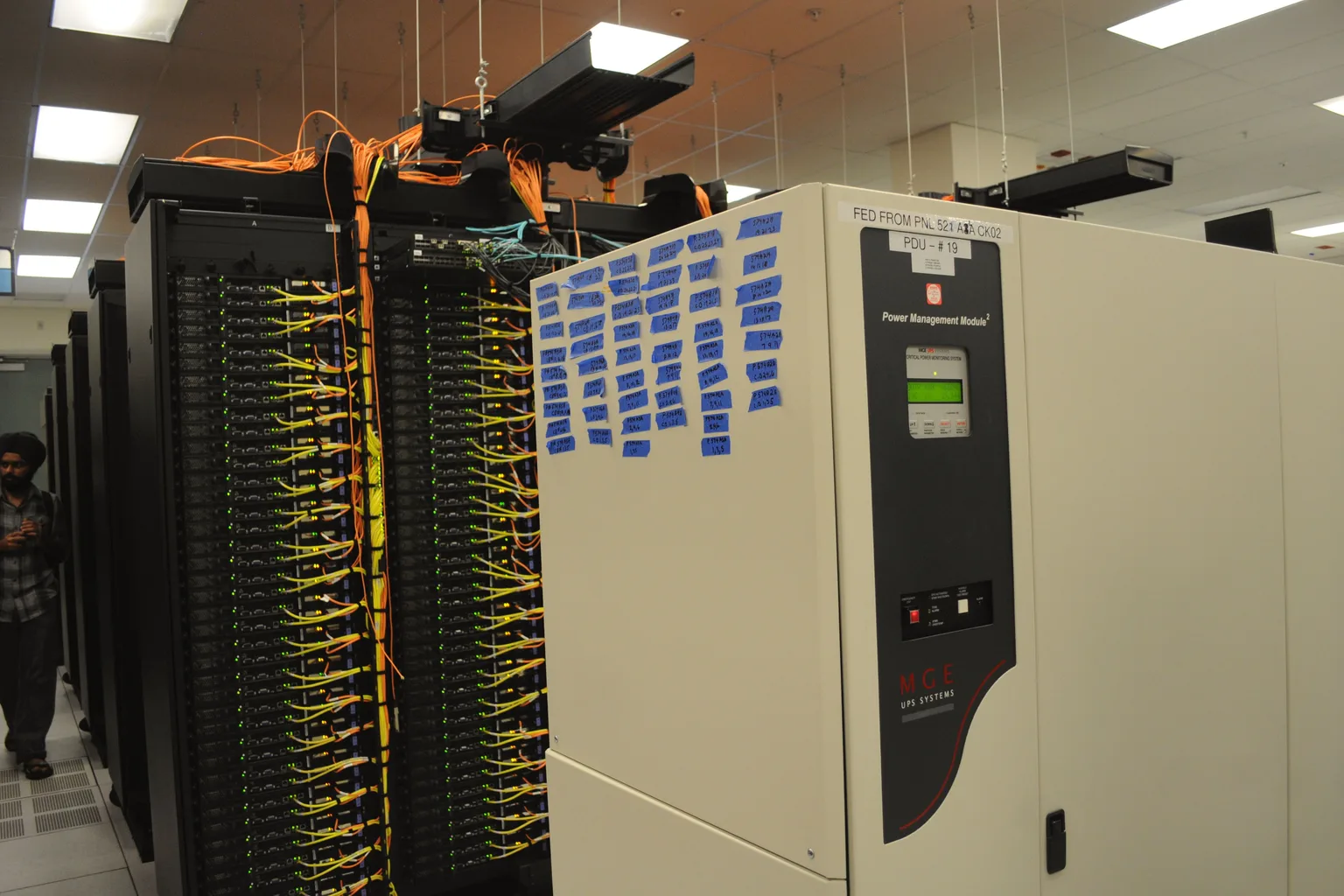
Photo: Derrick Coetzee, CC0, via Wikimedia Commons
Distribution is the stage that divides electricity received from a substation among buildings and equipment, and cuts it off to protect the system when a fault occurs. In a data center, uninterruptible power supplies (UPS), batteries and backup generators are added so that power is never interrupted, even for an instant. If the transmission grid brings electricity to the data center's door, distribution and internal power equipment carry it to each GPU.
This stage is less well known than generation or transformers, but it is where AI servers have changed the most. As the power of a single rack grows from tens of kW to hundreds of kW and then 1 MW, the way electricity is carried is itself changing, and large batteries (ESS) are arriving to deal with the sudden load swings that AI training creates. Part 4 covers the power path inside a data center and the role of each piece of equipment, with figures for distribution companies such as LS ELECTRIC, Vertiv and Eaton and for storage companies such as Tesla and LG Energy Solution.
Power Is the Next Bottleneck After Nvidia series. Part 1: Why power is AI's bottleneck · Part 2: Generation (gas turbines, nuclear) · Part 3: Transformers, transmission, cables · Part 4: Distribution, data-center power, storage · Part 5: Is power a better investment than chips?
The Path Electricity Takes Inside a Data Center
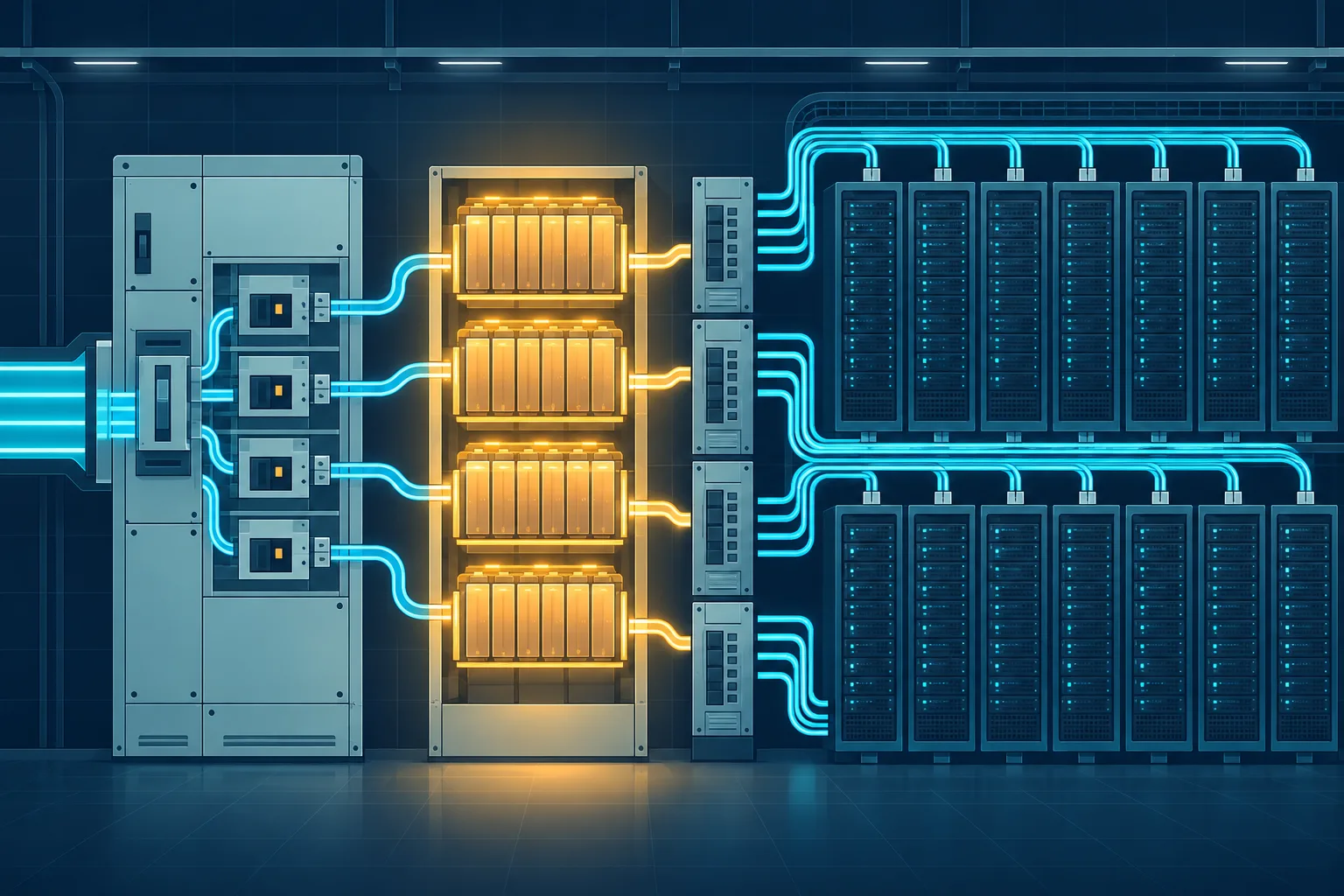
A data center usually receives power from the utility over two or more lines (IEA, Apr 2025). The incoming power is divided at high-voltage switchgear, stepped down by a transformer to the low voltage used in the building, passed through a UPS, and then carried by power distribution units (PDUs) and busways to each server rack. In an outage, the UPS battery holds the load for several minutes to about an hour while backup generators start.
What AI Racks Changed: 800V DC and the Copper Problem
Most server racks today convert AC to 54V DC inside the rack. In a technical blog post on May 20, 2025, Nvidia explained that this approach hits a physical limit once a rack exceeds 200 kW. Running a 1 MW rack at 54V would require up to 200 kg of copper busbar alone, and the power supplies would take up nearly all the rack space, leaving no room for compute equipment.
Nvidia's proposed fix is to convert 13.8 kV AC to 800V DC at the data center entrance and deliver it to the rack. Nvidia argued that the same conductor can carry 85% more power, copper use falls 45%, and overall power efficiency can rise by up to 5%. It plans to introduce 1 MW-class racks from 2027 and named Eaton, Schneider Electric and Vertiv as data center power system partners.
This transition is both an opportunity and a risk for distribution companies. Those that bring out products for the new standard first can gain share, but the weight of existing AC equipment could shrink. Vertiv's top executives also said on their July 2026 earnings call that "800V adoption will be gradual," expecting customer validation in 2026 and deployment in 2027.
LS ELECTRIC: A Company That Grew on North American Data Center Distribution
LS ELECTRIC's main business is distribution equipment such as high- and low-voltage switchgear, breakers and switches, and it also makes the extra-high-voltage transformers covered in Part 3 and automation equipment. Of its roughly KRW 1.3 trillion in North American revenue in 2024, more than 70% was medium- and low-voltage equipment and switchgear. In the data center power chain, it sits behind the substation, dividing and protecting the electricity that enters the building.
Q2 2026 results were revenue of KRW 1.577 trillion (+32.2%) and operating profit of KRW 178.5 billion (+64.4%), both quarterly records, with a backlog of about KRW 7 trillion. North American revenue was about KRW 400 billion, around 25% of quarterly revenue (Insight, Jul 23, 2026). iM Securities estimated LS ELECTRIC's North American data center orders at about KRW 800 billion in 2025 and more than KRW 1.2 trillion in the first half of 2026 (Money Today, Jul 13, 2026). In April 2026, it agreed to supply about KRW 319.0 billion of distribution equipment to fuel cell company Bloom Energy for a hyperscale data center in New Mexico.
Chart data
Chart summary: LS ELECTRIC (010120) daily candles, 2024-01-02 to 2026-10-12. Close 73,300 KRW → 183,600 KRW (+150.5%); period high 907,000 (2026-03-20), low 63,100 (2024-02-28). Marked: Post-holiday dip 2025-01-31 close 231,000, Closing high 2026-05-07 close 318,500, Day after Q2 2026-07-24 close 202,000.
Distribution equipment has shorter lead times than transformers. In Wood Mackenzie's survey, average switchgear lead time was 44 weeks, about a third of the 128 weeks for power transformers. iM Securities also called LS ELECTRIC's data center orders a "relatively short-delivery structure." Orders turn into revenue quickly, but the period the backlog covers is short. Based on 2025 revenue of about KRW 4.96 trillion, the sum of the quarterly figures, a KRW 7 trillion backlog is about 1.4 years of work. The day after it reported record Q2 results (July 24), the stock fell 9.62%.
Vertiv, Eaton, Schneider and ABB: The Global Big Four in Data Center Power Equipment
Power equipment inside the data center is a market that US and European companies have long dominated. Vertiv is a specialist that sells UPS, PDUs and cooling equipment only to data centers, while Eaton, Schneider Electric and ABB are electrical equipment companies that make everything from distribution to UPS.
| Company | Role in the data center | Latest figures | Source |
|---|---|---|---|
| VertivVRT | UPS, PDUs, cooling (including liquid cooling), Nvidia 800V partner | Q2 2026 revenue of $3.274 billion (+24%), full-year guidance raised to $13.8-14.2 billion | Vertiv earnings release (Jul 29, 2026) |
| EatonETN | Switchgear, breakers, UPS, transformers, cooling (Boyd Thermal acquisition) | Q2 revenue of $8.531 billion (+21%), Americas electrical orders +41% (12-month rolling average), backlog +33% | Eaton results (SEC filing, Jul 31, 2026) |
| Schneider Electric (France) | Distribution, UPS, cooling, management software | First-half 2026 revenue of EUR 21.2 billion (+14% organic), data center demand "very high" | First-half results (Jul 30, 2026) |
| ABB (Switzerland) | Distribution, high-voltage UPS, power equipment | Q2 2026 orders of $12.042 billion (+30%) | Q2 results (Jul 16, 2026) |


Vertiv's backlog at the end of 2025 was $15 billion, up 109% in a year, and its fourth-quarter book-to-bill ratio was about 2.9. It has not disclosed the backlog amount since. In Q2 2026, revenue fell short of market expectations (about $3.38 billion), and the company cited "temporary supply chain congestion."
Eaton has widened its data center business through acquisitions. It bought Fibrebond, a maker of modular power equipment for data centers, for $1.43 billion in April 2025, and cooling company Boyd Thermal for $9.55 billion in March 2026. The move to supply power and cooling together points the same way as Vertiv's acquisition of a liquid cooling company.
Institutional Holdings in 13F Filings: Vertiv Is Split Evenly Between Adding and Cutting
In the 13F filings that Trading Journl collects, the Q2 2026 changes in institutional holdings of Vertiv and Eaton are as follows.
Source: SEC EDGAR 13F (Q2 2026), Trading Journl tally (as of Oct 12, 2026)
For Vertiv, the number of institutions adding (45) and cutting (43) was almost equal. BlackRock, the largest holder, cut 3.5% and JPMorgan added 65.9%. A 13F reflects holdings at quarter end and is published up to 45 days later, so it is better treated as a supporting check on the direction of institutional flows than as a trading signal.
ESS: Why Large Batteries Are Coming to Data Centers
An energy storage system (ESS) stores electricity in batteries and releases it when needed. Data centers already had UPS batteries for outages, but AI data centers now need larger batteries for two reasons.
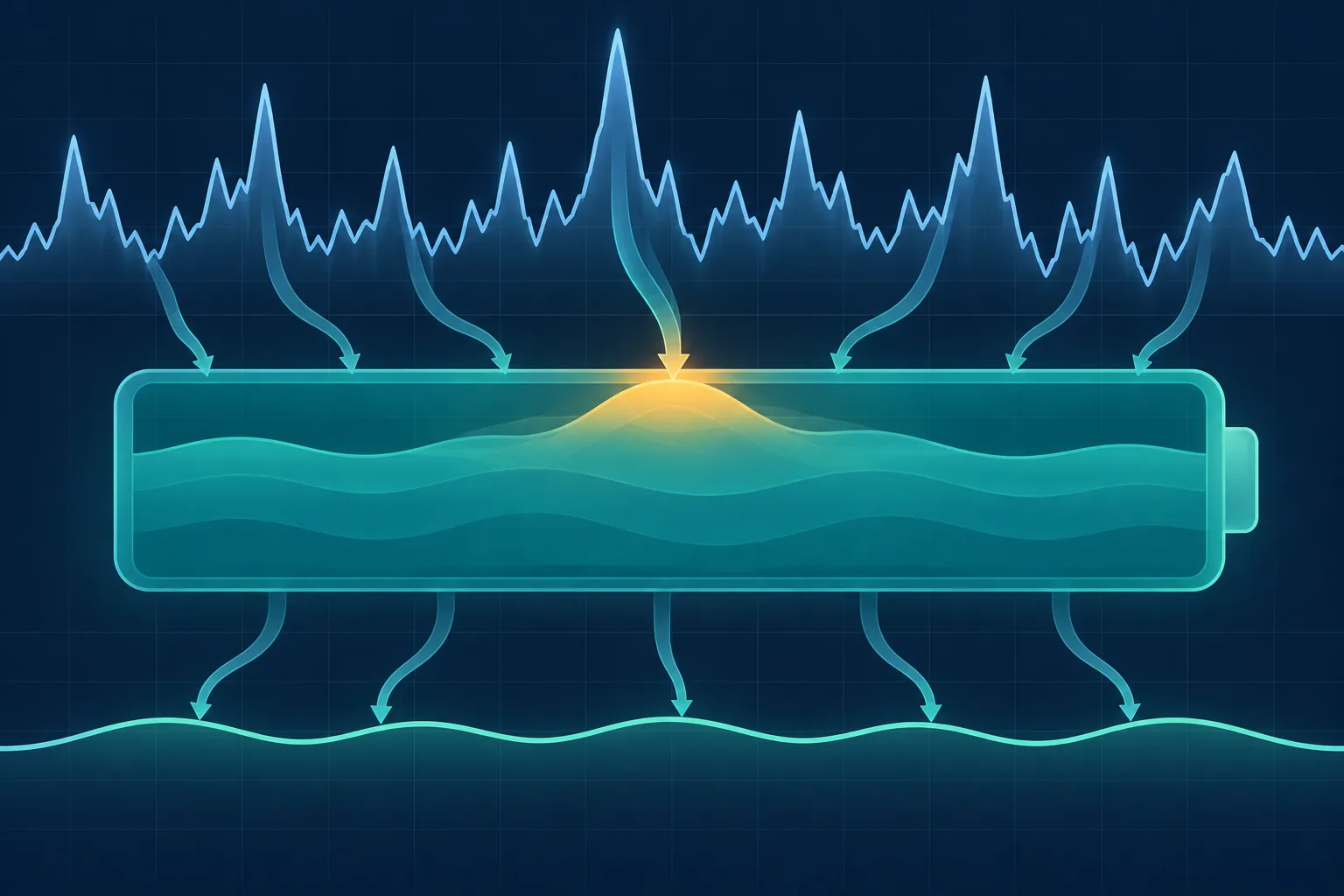
The first is load swings. In AI training, tens of thousands of GPUs compute at the same time and pause at the same time, so power use rises and falls sharply within a short span. Semiconductor analysis outlet SemiAnalysis summarized that Meta observed swings on the order of tens of MW in a cluster of 24,000 H100s (Jun 25, 2025). Swings like this can shake the grid, so batteries absorb them by charging and discharging.
The second is the grid bottleneck. On its July 2026 earnings call, LG Energy Solution's chief financial officer said that "installing ESS is essential in AI behind-the-meter (BTM) projects to reduce extreme power load volatility," and explained that Big Tech is building its own power infrastructure because of grid bottlenecks.
ESS Companies: Tesla, Fluence, LG Energy Solution and Samsung SDI
| Company | Role | Latest figures | Source |
|---|---|---|---|
| TeslaTSLA | Megapack (large ESS) systems | ESS deployments of 31.4 GWh in 2024, 46.7 GWh in 2025 and 13.7 GWh in Q3 2026 | Tesla production and delivery releases |
| Fluence EnergyFLNC | ESS system integration | Backlog of about $6.4 billion (record), full-year revenue guidance cut to $2.9-3.1 billion | Fiscal 2026 Q3 results (Aug 5, 2026) |
| LG Energy Solution373220 | LFP battery cells and systems for ESS | Q2 ESS revenue more than 4 times a year earlier, first-half new orders above KRW 3 trillion | Q2 2026 earnings release (Jul 30, 2026) |
| Samsung SDI006400 | Batteries for ESS, UPS and BBU | Q2 operating profit of KRW 203.8 billion, first profit in seven quarters | Q2 2026 results (Jul 30, 2026) |


Tesla's ESS deployments rose about 49% from the prior year to 46.7 GWh in 2025. xAI's Colossus data center also uses Tesla Megapacks. But deployments fell to 8.8 GWh in Q1 2026 before recovering to 13.5 GWh in Q2 and 13.7 GWh in Q3, so they swing widely from quarter to quarter.
US regulation has become an opportunity for Korean battery makers. The One Big Beautiful Bill Act (OBBBA), passed in July 2025, requires ESS projects that begin construction after 2026 to source a minimum share of component costs from suppliers that are not "prohibited foreign entities" such as Chinese firms in order to qualify for tax credits (at least 55% for ESS in 2026, rising over time, Bracewell, Jan 16, 2026). In July 2025, LG Energy Solution disclosed a KRW 5.94 trillion (about $4.3 billion) LFP battery supply contract, and the US Department of the Interior confirmed the customer as Tesla in March 2026. The supply period runs from August 2027 to July 2030.
The quality of earnings needs to be looked at separately, though. LG Energy Solution's Q2 operating profit of KRW 113.3 billion includes KRW 241.0 billion of US production tax credits (AMPC), so without the credits it is still a loss. The company itself set Q4 as its target for an ESS profit excluding the credits.
Limitations and Risks When Looking at Distribution and ESS Companies
First, this group is among the most sensitive to AI demand. At the closing prices on January 27, 2025, the day of the DeepSeek shock, Vertiv fell 29.9% and Eaton 15.6%, similar to or larger than Nvidia's 17.0% drop. Vertiv trades about 35% below its May 2026 high.
Second, the shorter the lead time, the shorter the period the backlog covers. Unlike gas turbines or extra-high-voltage transformers, which carry several years of work, a delay in data center construction shows up in results faster. One analysis says 30-50% of large data centers worldwide scheduled to come online in 2026 will be delayed by power shortages, equipment shortages and local opposition (Sightline Climate, Feb 2026).
Third, there are execution and technology risks. Vertiv's revenue missed expectations because of supply chain problems, and Fluence lowered its full-year guidance on a production delay at a new contract manufacturing facility. The shift to 800V DC could change equipment standards, and ESS company earnings depend heavily on US tax credits and rules on China.
Checkpoints for Investors
- Have you checked what share of a company's revenue comes from data centers and how long it takes those orders to turn into revenue (lead time)?
- For a company that does not disclose its backlog, have you checked substitutes such as revenue guidance and the book-to-bill ratio?
- Is the company a partner in new standards such as 800V DC?
- What are an ESS company's earnings once the share from US tax credits (AMPC) is removed?
- If a stock fell after good quarterly results, have you recorded whether the reason was guidance or expectations?
Frequently Asked Questions
Q1. Are a UPS and an ESS the same thing?
Both use batteries, but their purpose and scale differ. A UPS keeps power flowing for several minutes to about an hour during an outage or a momentary voltage problem so servers do not shut down, acting as a bridge until the backup generator starts.
An ESS is equipment that stores electricity in a much larger battery and releases it when needed. In data centers, it is used to absorb AI training load swings, to serve as an on-site power source when the grid falls short, or to provide ancillary services to the grid. Recently, placing a small battery (BBU) inside the rack has also become more common.
Key Takeaways
- Distribution and data center internal power is the stage that divides incoming electricity at switchgear and delivers it to server racks through transformers, UPS and PDUs.
- As AI rack power grows to the 1 MW class, Nvidia has proposed an 800V DC architecture, with Eaton, Schneider and Vertiv taking part as partners.
- LS ELECTRIC posted quarterly records in Q2, with revenue of KRW 1.577 trillion and operating profit of KRW 178.5 billion, and its North American data center distribution orders have grown quickly.
- Vertiv, Eaton, Schneider and ABB grew orders and revenue by double digits on data center demand, but Vertiv's Q2 revenue missed expectations.
- AI training load swings and grid bottlenecks have raised ESS demand, and US rules have helped LG Energy Solution and Samsung SDI win US customers such as Tesla.
- The risks are short lead times that shorten the period a backlog covers, the highest sensitivity to doubts about AI demand, and ESS earnings that depend heavily on tax credits.
References
- IEA, "Energy and AI" (Apr 2025)
- NVIDIA Technical Blog, "NVIDIA 800 V HVDC Architecture Will Power the Next Generation of AI Factories" (May 20, 2025, revised Jul 31)
- Vertiv Q2 2026 earnings call transcript (Jul 29, 2026), earnings release (Jul 29, 2026), and Q4 2025 results (SEC Form 8-K, Feb 11, 2026)
- Yahoo Finance, report on Vertiv's Q2 2026 results (Jul 2026)
- Insight, report on LS ELECTRIC's Q2 2026 results (Jul 23, 2026)
- Money Today, report on iM Securities' analysis of LS ELECTRIC's North American data center orders (Jul 13, 2026)
- Financial News, report on LS ELECTRIC's distribution equipment supply to Bloom Energy (Apr 29, 2026)
- Daum News, report on LS ELECTRIC's order for switchgear for a US Big Tech data center (Sep 3, 2025)
- Meritz Securities, issue comment (Feb 3, 2026, LS ELECTRIC quarterly results table)
- POWER Magazine, "Transformers in 2026: Shortage, Scramble, or Self-Inflicted Crisis?" (Jan 2, 2026)
- Eaton Q2 2026 results (SEC filing, Jul 31, 2026)
- tEDmag, "Schneider Electric delivers strong half-year results" (Jul 31, 2026)
- Inderes, "ABB Ltd Q2 2026 results" (Jul 16, 2026)
- SemiAnalysis, "AI Training Load Fluctuations at Gigawatt-scale" (Jun 25, 2025)
- LG Energy Solution Q2 2026 earnings call script (Jul 30, 2026)
- Samsung SDI Q2 2026 results release (Jul 30, 2026); Dailian, report on Samsung SDI's conference call (Jul 30, 2026)
- Tesla production and delivery releases (SEC Form 8-K, Jan 2, 2026, and Oct 2026); ESS News, reports on Tesla ESS deployments (Jan 3, 2025, and Jul 2, 2026)
- Fluence fiscal 2026 Q3 results release (SEC Form 8-K, Aug 5, 2026)
- ESS News, report confirming the customer in the LG Energy Solution and Tesla LFP contract (Mar 18, 2026)
- Bracewell, "FEOC Material Assistance Rules for Clean Energy Tax Credits" (Jan 16, 2026)
- Latitude Media, "Up to half of the world's data centers may be delayed this year" (Feb 24, 2026)
- SEC EDGAR 13F filings (Q2 2026), Trading Journl 13F tally
- Stock prices: Alpaca and Yahoo Finance daily bar data (calculated on closing prices)
For reference only: The information in this post is provided for general reference and does not constitute investment advice or a solicitation to trade. Your responsibility: Final investment decisions and their outcomes are entirely your own. No warranty: This information is not guaranteed to be accurate and cannot be used as a basis for legal liability for any investment result.